Showing posts with label language learning. Show all posts

06 August 2013

Jalapeños in Helsinki

A few years ago, one of my retired graduate school mentors dropped me a line after his first-ever trip to Finland.  He saw many people that resembled me, which he explained as persistent evidence of inbreeding in a still relatively insular society.  (I was amused by this characteristic observation from a confirmed sociobiologist).  On my recent trip to Finland after two years in southern France where people seem shorter and smaller and have more dramatic coloring, I did feel like my blonde hair, pale skin, and height were just about average.  In my own sociological view though, what really stood out for me on my visit was how globally diverse Finland has become, and how easily English rolled off people's tongues.

I was thrilled to discover so many people of foreign origins speaking Finnish fluently.  There was the man of Chinese, or perhaps Korean origin, who sold me a hat at the flea market in Naantali; his Finnish had a lovely inflection as did the Helsinki bus driver's, whose native tongue was probably Arabic.  At the airport, the young grocery store cashier with the dark, perhaps African complexion seemed to have absolutely no accent that I could detect, nor did the airline agent of Somali or north-central African origin.  Aside from a course I took many years ago in Helsinki with other young students from mostly Europe, I have never before heard fluent Finnish spoken by such a diverse group of people. In the past, it was my accent or inflections that puzzled Finns who couldn't quite place my origins.  Today, many more immigrants have come to Finland from beyond Europe, settling in to work and learn the language of their new country.

I was also pleasantly surprised by the ease with which young Finns slip between English and Finnish.  When I was younger, just the shop clerks at the big department stores and flight crews spoke English comfortably, but now, museum ticket-takers, waiters, ice cream stand sellers, apartment managers, all effortlessly switched to English when my husband was talking, and then switched back to Finnish when I spoke up.  Today, English is the first foreign language that Finnish schoolchildren take in school, and it is then followed by, instead of preceded by, the second national language, Swedish.  This, along with the ubiquitous English-language television programming which is subtitled but not dubbed as it is in France, means that Finns are broadly exposed to English.  It is after all the official language of the EU.  Yet it doesn't appear that Finnish is disappearing by any means, as it clearly remains important for the immigrants who make Finland their home.  As with many languages, external influences are enhancing how the Finnish vocabulary develops.  In a short article in a Finnish women's magazine, the chairperson of the Left-Wing Youth used many Anglicisms: would people get the 'pointi', if women 'sheivaa' or not their body hair? ("Antaa Rehottaa", Me Naiset, 1.8.2013, nro. 31, p. 16).

Finally, we also observed that the foreign culinary influence in Finland has widened, as we discovered jalapeños on our hamburgers and pizzas! Subsequently, we noticed the proliferation of Mexican-influenced restaurants in Helsinki.  While we enjoyed eating certain uniquely Finnish foods (the meat pies, the rice pasties, Fazer chocolates and candies), we did appreciate the flavor enhancements brought about by globalization.  Apparently, so do other Finns.  In a newspaper interview comparing the values of Finnish elites and ordinary people (that I happened to catch a glimpse of at the Cafe Strindberg on my second to last day in Helsinki, "Homoliitto erotti eliitti-Benin ja kansa-Karon" by Hannu Tikkala, 4.8.2013, Helsingin Sanomat), the Finnish guy representing the point of view of ordinary Finns pointed out that having international workers and people in Finland means that Finland gets better food...and better-looking people.  While I don't know about the latter, there are clearly benefits associated with the global movement of people, languages, and traditions.

19 July 2013

La jeunesse

Two paintings by Agnolo di Cosimo, Firenze, Uffizi, 1540's
One of my favorite lessons in my sociology of family course is on the changing meanings of childhood.  Some argue that children in the past centuries were essentially treated as little adults, contributing to household economies and serving as means by which to solidify family alliances.  Only later when the industrial revolution altered familial functions and roles do we see the emergence of childhood as a special stage of life. Children's ages and feelings may not have changed, but how they are viewed and presented in society has, which is another way of saying that while age may be reflected physically and psychologically, it is also social.  (The images above portray children of the Medici family as small adults.  From our contemporary view, we might guess that these children were chafing in those adult-like outfits and poses.) We also have cultural and class-based variations in our understandings of childhood;  I have learned this week that the French often call adolescence l'âge bête, which conveys the idea that humans are born uncivilized.  It is through childhood and adolescence that they are taught to curb their animal-like natures in order to become productive and upstanding members of society.  In the U.S. we currently have multiple trends, where children are pushed to become little adults and over-achievers, or are seen as capable decision-makers with whom we can reason, or are left to their own devices.  The social understandings of age continue to evolve, as meanings of childhood, of la jeunesse (youth), of young adulthood, and even middle age and old age change, due to economic conditions and changing perceptions of marriage, non-marital sexual activity, parenthood, and longer life spans.

This week I have had further affirmation of how age is a social feature but also an inner state of mind that may not always correspond to the social meaning.  For the past three weeks, I have been part of the first cours intensif de francais (French intensive language course) at the shiny new Alliance Française language school in Aix.  Alongside my Chinese, English, and Spanish classmates, I have been eagerly and diligently working my way through French subjunctives, gerunds, and transitional phrases, just like an eager-to-please first grader in the front row of her classroom.  As a small class, we are all struggling, laughing, and succeeding together, deciphering oral dialogues and correcting the order of double pronouns, pronouncing difficult words so they don't sound like vulgarities (pourtant: pronounce the r, otherwise you get a bad word), learning useful phrases for phone texting, like à + (à plus, which is short for à plus tard, see you later), and ways to describe, or envisager, our dreams for our future.  We take our coffee or tea breaks together and bavarder (chat) a bit.  It seems like we are in the same boat.

But in fact, we are not.  One young classmate has a musical career with a traveling orchestra, while the other two are still students, embarking on post-undergraduate studies in Paris this fall and are in the midst of finding affordable apartments and figuring out bank accounts and cell phones.  I am twice the age of these students, okay...over twice the age, and I am in a completely different life stage.  Just the other day, we took turns selecting discussion questions, and I realized that I chose ones that clearly reflected my current situation as the mother of adolescents, while the students are in intimate relationships.  Learning French, and moving to a new country, yes, we have those things in common, but it is so interesting to realize that one can feel so youthful and so old en même temps!  (at the same time!)   It's not a feeling I often have, as a university and college instructor where I instruct many students the age of my current classmates.  As a temporary student myself though, I guess I feel 21 again, despite my outward appearance and my life stage.   That's what is so confounding, that one can feel much younger (or older) than one's social age.  Fortunately, my classmates don't see my social age as too much of a barrier; we might even go out for drinks next week.

03 June 2013

La phonétique française

In recent months, an English friend and I have been exchanging examples of what we find to be amusingly vague artistic descriptions of French cultural events and performances, particularly as we've come across them in regards to the Marseille Year of Culture.  (You can find out more about this Year of Culture's happenings at www.aixcentric.com.)  My latest find is from the website of the French performance company that put on a huge spectacle (performance or show) in Aix last Saturday night.  The professional company Transe Express describes itself as inventors of imagination:

Transe Express play in open spaces to provoke the meeting of a public. Without limitation, the artistic mediums and modes of expression are the ingredients for our creators. Music, visual arts, prouesses, circus skills, fire, literature, metallurgy, opera, rock, dance, with a preference for theatre, found at the corner of each of our philosophical stones. Shock creations which at times invest a stage, non-conventional spaces but principally the streets ; Intriguing the public in their everyday lives ; Unique adventures to transform a city, to «dress» a strong moment of an era. The team is constituted of a hundred actors, aerobats, acrobats, bell ringers, dancers, percussionists, singers, string quartets, welders, technicians, forgers and others that make up the motley crew who regularly realises the project of the Company : Ephemeral creations or repertoire shows, close proximity, aerial or ambulating spectacles.


No, this isn't a bungled translation from French; it's meant to sound like this, and I've read many equally and strangely vague descriptions in French.  In a way, the language reflected the show we saw, which was really amazing, but also really hard to describe precisely.  (We've had other similar experiences last summer, see Les spectacles, July 2012).  This time, along the main boulevards in town, we saw floats of giant human dolls singing in opera-rock falsettos, acrobats playing the drums with their bodies, and giant mobiles of human musicians swaying under construction cranes in the night sky.


All of this floatiness, in how some French express themselves in words and actions is perhaps related to something else I only just realized concretely about the French language, and that is that French is not a phonetic language.  The precise sounds and pronunciations (and sometimes spellings) that I use as my guides, especially as these come from Finnish and even from German, should really be forgotten when it comes to pronouncing and trying to understand spoken French.  I took an illuminating course on la phonétique française (French phonetics) this year in which I learned rules about the sounds French words make.  One learns about the sounds themselves by learning how to use the lip and tongue in slightly different combinations, and then these sounds correspond to so many different spellings that it's hard to keep everything straight.  I don't have them down well yet, but I do better understand that I can swallow quite a number of letters in many words.  For example, for non, nom, n'ont (no, name, don't have), I can just drop the last letters when speaking, or I should listen really, really carefully to the context because these are all pronounced exactly the same (approximately: noh).  It all feels very loose and imprecise.  I even get tripped up on phrases that aren't homophones as there are plenty of rhyming sounds in French that can also trick unsuspecting listeners.  How about the radio story last week about the anti-gay marriage protests which were led by what sounded like Brigitte Bardot?  I thought her thing was animal rights?  In fact, yes, she is the former French hottie-turned animal rights activist, and it's a woman named Frigide Barjot, who is involved in the anti-gay rights protests...who has taken on this name as a pun on Mme Bardot's name, amusing herself and also obviously confusing foreigners trying to get a handle on French!  Here's what I think: maybe the lack of phonetics in French, all the many different spellings that come with the same sounds or almost similar sounds that change just a bit with little changes in one's lip and tongue positions, maybe all this looseness is somehow related to the floaty, ephemeral, gauzy, non-conventional, limitless fashions in which the French language mirrors and paints pictures in the sky, of adventures and breathtaking spectacles which capture our collective philosophical imaginations...?

11 February 2013

Ponts

As  I prepare my online courses for each quarter, I frequently think about ways to engage my students actively.  The emphasis on active learning is especially strong at the community college-level, where more personalized instruction is often possible and learning outcomes are frequently tied to active learning strategies, but I employ such strategies as much as I can at the university level too.  Active learning strategies are essentially a pont (a bridge) between the abstract concepts we teach and the concrete understanding of these.  By engaging learners actively in understanding a concept or procedure or way of thinking, such as through experience, or a project, or experiment, we hope to create higher-order and more independent thinking.  Some of the bridging strategies we employ today are new to higher education, but in other respects, we have long employed active learning strategies in education.  In particular, I am thinking about the field trip, or the school trip.  Such trips offer active, experiential learning that can enhance what has been learned previously in a classroom.  I fashion field trips for some of my online courses, where I ask students to do an independent field observation of social behavior, or for my face-to-face courses when I require service learning or when I have walked students to spaces on campuses to show concretely what sociologists can learn from outside stained glass windows (in my sociology of religion course) or from library-provided research databases (in my introduction to sociology course).  Field trips are of course common in the U.S. at the compulsory educational level.  I for one have many memories of school field trips, such as the one to plant fir seedlings on the Olympic Peninsula in 6th grade, or another one in high school, to Seattle (the big city!) to perform in a marching band competition.
 
Active learning opportunities in the form of school exchanges and field trips are also available all over the l'Union Européenne (European Union, the French reverse the EU).  The EU sponsors cultural bridge opportunities for schools across member states, such as those available under the Comenius Lifelong learning program.  From our U.S. perspective, these opportunities seem so cosmopolitan because they involve the crossing of national borders and multiple languages, whereas field trips across similar distances in the U.S. take us at most to another state.  But the active learning occurs regardless of where the field trips take students.  This year and next year, our boys' school is engaged in Comenius-sponsored bilateral school project with a middle school in Prague.  (Details about EU-sponsored Comenius Bilateral school projects are available directly on the EU website for Lifelong learning programs, click here  http://ec.europa.eu/education/comenius/school_en.htm  and then on the link to bilateral projects.)  Without explicitly say so, these bilateral projects are clearly meant to offer experiential and active learning opportunities through language learning, through the study of a theme of mutual interest, and through cultural exchange.  The project documentation also mentions the goal of 'enhancing the European dimension of education.' 

The subject of the bilateral project between Collège Auguste Mignet in Aix en Provence and Ďáblice middle school in Prague is the Czech composer Boruslav Martinů.  He studied and performed music in Prague, and after leaving his homeland en route to the United States, he made a brief visit to Aix, where he composed some music and developed a friendship with Aix composer Darius Milhaud (for whom the Aix music conservatory is named).  (Click here for a brief explanation of the project thus far, by the organizing teacher on the French school's website, in French.  Click here for my translation, in English.  And again here, for the Czech school's announcement of the project, in Czech. )  Martinů thus represents un pont entre deux cultures (a bridge between two cultures), while the bilateral school project itself offers a pedagogical bridge over which the students will make connections between what they are learning about Martinů at school and what they experience in the physical and cultural environment in which he did some of his work.  Of course, I see many sociological learning opportunities here as well, as the students will surely begin to recognize that underlying the cultural and linguistic differences are basic social and human qualities that we all share.

Right now, the French school's students are doing their 'detective work', as the organizing teacher calls it, to understand who Martinů was, and what his connection to Aix was.  They are also learning some basic Czech and rehearsing a theatrical piece inspired by Martinů and his life that they will perform while in Prague.  Our son's private piano teacher is helping him learn a bit about Martinů through his music, with a lively and challenging piano composition from Borová, his Seven Czech dances (in this case, the 7th dance).  The actual 10-day trip to Prague this spring will represent the high point of active learning, where students will gain understanding by crossing the bridge between abstract knowledge and concrete experiences, and during which they will no doubt trace Martinů's steps in Prague a bit, perhaps even crossing some of the same physical bridges as he did.  An equivalent learning experience will take place for the Czech students when they come to Aix the following year to see where Martinů lived briefly and composed.  While some of the learning on both sides is taking place in English, both groups of students will also be immersed linguistically and culturally within their host families on their respective visits.  As our family has so clearly discovered during our French adventure, such immersion is the ultimate active learning experience!

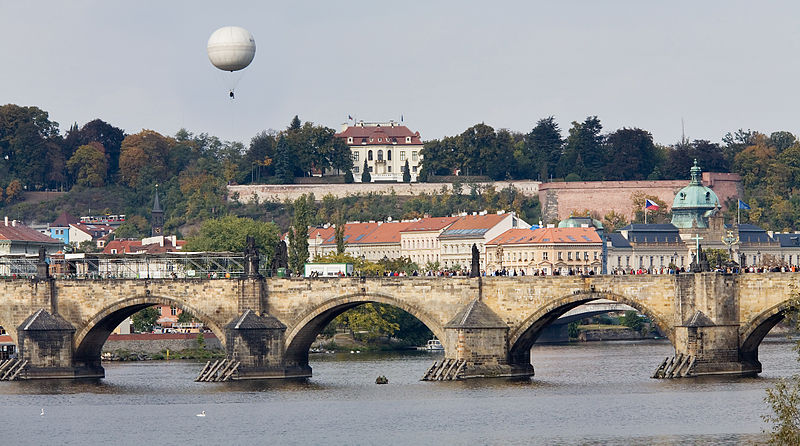
St. Charles Bridge in Prague © Jorge Royan / http://www.royan.com.arCC-BY-SA-3.0 under   Creative Commons Attribution-Share Alike 3.0 Unported

18 December 2012

Vrai ou faux?


As any English-speaking foreigner here knows, some of the most embarrassing language issues center on faux amis (false friends), those expressions in one language that seem like similar ones in another, but in fact, mean something entirely different.  They are like tricks, familiar enough to trip up the reader, and the more I try to learn French, the more it seems I stumble upon them.  For example, one of my friends (a real and true human one) was telling me a few weeks ago that she was going to Marseille to buying some baskets for her daughter for Christmas because she couldn't find the right ones in the right size in Aix.  I wondered just what kind of sweet little baskets she was looking for.  Well, it wasn't the wicker kind at all, but the kind pictured here, because baskets are not baskets in French, but high top sneakers.  (A basket is a panier or corbeille in French.)  Similarly, when we first arrived in Aix, I was asked by someone if my twins were vrai ou faux (true or false).  I managed to keep my indignation to myself when I realized that in fact, those two boys whom I carried for nearly 9 months and birthed as twins are not vrai jumeaux (true, or identical twins) in French, but faux (fraternal, or false) ones, however false it feels to call them that.  Much of French usage is context-based, and there are many of these faux 'faux amis' where a single word can actually mean two different things, depending on the context.  It's like this flocked-to-the-extreme red Christmas tree which I discovered this week on the street in Aix; it looks faux, but in fact is real!


Other language deceptions exist in the realm of pronunciation where there are an awful lot of superfluous letters in French which are not supposed to be pronounced, sometimes.  Those are false friends too in my view.  Young French kids learn French pronunciations and silent letters through memorization, aided by schoolbooks that cross out the silent letters.  I think that would be very helpful for adult learners.  For example, faux amis (silent 's', but do pronounce the 'x' as it carries over to the vowel in the next word: foe za mee) but vrai ou faux  (don't pronounce the x here, vray oo foe), and in those doubly fake friends, faux faux amis (the first x is silent, the second one is not, foe foe za mee).  See what I mean?

In fact, every language plays games with new language learners.  My first language, Finnish, offers nice pronunciation rules, in that every letter in a word is pronounced, so that sounding out words is relatively easy.  But learning what those words mean, and how to use them becomes very difficult when one realizes that long compound words are very common, and that there are over a dozen cases that must be learned; a word like vesi (water) becomes a very different word depending on whether you want to drink it, go in to it, moisten something with it, or are admiring it.  Dangerous deceptions lurk here too; years ago, when I was learning basic Estonian which is closely related to Finnish, I discovered plenty of faux amis, where a word in Finnish like halpa (inexpensive), used perhaps by Finnish tourists when marveling over cheap prices in Estonia, sounds very bad to Estonians because to them halb means bad, or poor quality.  Of course, English is difficult too, with the many homonyms (their, there, they're) and silent letters and difficult sounds: ch, sh, th.

The only consolation is that eventually after enough encounters with different kinds of faux amis, one learns from one's mistakes.  It's rare to meet a faux ami a second time.  Instead, over time, one is able to turn these false friendships into true ones where the once-tricky words or pronunciations actually become useful communication tools, for exchanging niceties, or asking questions, or even sharing confidences, say with neighbors, teachers, or friends.  At those times, the language used may still not come out correctly (it rarely does for me!), but at least there is enough there to create a true and real social connection.

03 April 2012

A is for Autoecole

Immersion is the best way to learn a language well, and a recent New York Times article reports on a study that shows that the brain patterns of language learners in an immersion course actually begin to mirror those of native speakers (How Immersion Helps to Learn a Language, by Sindya N. Bhanoo, April 2, 2012, The New York Times).  One can imagine that the nuances of language and meaning are perhaps more easily recognized when one experiences these in real language settings, such as our boys are in the classrooms and hallways at French public school.  Learning the subtleties of French words and phrases is  something my spouse and I are facing ourselves, as we embark on our own quasi-immersion educational experience, through French autoecole (driving school).  Because auto insurance for foreign licensed drivers in France ends after one year, we must get les permis de conduire français (French driver's licenses).  (Some U.S. states have agreements with France to exchange licenses across the board, but not Washington state.)  As new driving school students, we have been immersed in driving terms and scenarios as we read and learn about when we may depassér (to pass), rabattre (to reinsert into a lane), ralentir (to slow down), arrêter (to stop), and cedez le passage (yield).  We are also learning some other subtle nuances, in French language and culture, from this driving school experience:

1-Getting a French driver's license is expensive: 780 euros per person.  This is our school's adjusted plan (as holders of foreign licenses so we probably won't need as many practical driving lessons because we actually know how to drive...).  That's nearly 1000$.  Getting a driver's license is truly a privilege here, not a right.  And it's no wonder  there are almost as many autoecoles in Aix as coiffures (hair salons); they represent a money-making opportunity.  There are literally 5 such schools within very short walking distance of our apartment, and they are little more than storefronts with very simple furnishings.


2-Passing the French theoretical driving test is challenging and requires understanding many nuances of meaning and context.  We have to memorize Code de la Route, (the rules of the road): 224 pages of panneaux (road signs), interdictions (prohibitions), obligations (obligations), sanctions and countless details about how and where to park, how much gas we save by driving 120 km/h instead of 130 km/h (answer: up to one liter!), and where we are supposed to store the gilet (reflective safety vest) that every car must have in the event of a car breakdown (answer: in the glove compartment).  The 40 theoretical questions are based on videos of driving scenes, and there is a time limit for each question, the questions may have more than one answer, and the situations and questions are often tricky.  For example, what does the white/red sign with 90 on it means?  That I must not exceed 90 km/h, but there might be three answers because I can drive 70 km/h, 80 km/h AND 90 km/h under such a posted limit.  What does it mean if that sign is posted in a foggy scene? My answer is that I must not exceed 50 km/h, the rule for driving in foggy conditions, regardless of the posted speed (and I could drive 30 km/h or 40 km/h if those are choices also).  If the sign is blue? I should drive at least the stated speed, because a blue sign is a sign of obligation, not one of prohibition.  To pass the exam, we must score above 35.  We are NOT there yet.  We met one Franco-American student with an expired U.S. driver's licenses who told us he spent 5 weeks, up to 6 hours a day, practicing for the written exam.  For us, the language barrier is one reason for the difficulty, the nuances are another, and....see point 3 for yet another.


3-Passing both the theoretical and practical driving exams means ignoring or forgetting everything related to actual French driving.  One must not rely on one's experiences or observations, or even the suggestions of any French driver.  Because parking on the sidewalk, honking the car horn in an urban area, crossing a solid white line to stop or park, using rear fog lights in the rain, and ignoring a vehicle with flashing blue lights, are all actually NOT permitted, even though they are completely regular, common, every day automotive practices in France.  I had barely pulled out of our parking garage on Sunday determined to 'practice' driving by following the French rulebook, such as carefully using my turn signals and slowing down as appropriate, when in the space of just a few blocks, a driver pulled out behind me and drove down the one way street in the opposite direction, another one blatantly ignored a yield sign, while a third one used the incorrect lane to enter the roundabout and then cut in sharply in order to exit straight ahead.  And all around me were illegally parked cars.  The message we are getting, and which most French probably already realize is, "Do as I say [in the Code de la route], not as I do [in real French traffic]."

The rewards for completing this remarkable educational journey?  We'll be legal drivers, our licenses will last virtually forever, and we'll qualify again for auto insurance.  We will also get the dubious reward of an actual red, solid A.  Many who know me know that I've always worked really hard for solid A's.  This time the A we're working towards stands for probatoire (licensed driver on probation), and probatoires display red and white A decals on their cars and drive at reduced speeds (110 km/h instead of 130 km/h, and 80 km/h instead of 90 km/h) for three entire years before they can be considered regular drivers (and attain their full number of driving points; this is another subject for another post).  My spouse is particularly incensed by this A reward, given our nearly three decades of licensed driving in the U.S. and his impatience with slow driving.  I am just giggling over the absurdity of it all, while trying simultaneously to appreciate the linguistic benefits of being immersed in the rules about French stationnement (parking), the safety features of les tunnels (tunnels) and the ways in which des pneumatiques sous-gonflés (underinflated tires) add to my fuel consumption. 

(Image from http://gestion.v2.permisapoints.fr/templates/frontoffice/infractions/images/infractions/permis-probatoire.jpg)

15 March 2012

Rêves

Upon discovering that I live in Aix, someone from the U.S. suggested to me that I am living 'the dream life of the 21st century.'  I like the sound of that!  The south of France IS dreamy.   The fountains and quaint streets and squares of Aix and many other Provençal towns are almost like movie sets, and the light here in the south of France, even when the sun is partially hidden, is surreal. (I see why it has been so popular with artists like Picasso, and why the British come here in droves.)  There are some truly dream-like spots, like the little restaurant I tried today, tucked away on a quiet street in Aix, with its almost-secret garden and sweet decor (the vintage French grocery store look), and we are dreaming of the first warm evening in which we can sit on our south-facing balcony to enjoy a languid meal and glasses of rosé as the sun sets.  And certainly, the fact that we are living and working in Europe is the fulfillment of a mutually shared dream, and in my case, that I can teach online for my U.S. institutions while living abroad is so 21st century.


Apparently, that rêve (dream) is not be shared by all of us though. When I suggested to my pre-teen sons over dinner that we are living a dream life, they gave me disdainful looks that mean I must be out of my mind.  Their so-called dream life just involved a few hours of homework, some of it in French(!), after a long day of school, some of it in French(!), that ended at 16h (4 pm), AND their math teacher signed their class up for a special exam in French(!) to be taken on what is normally their Friday afternoon off.  Pffft! Who was I kidding? 


No kidding, but it's that idea of the social context again.  What looks like a dream life abroad for some or even a vacation paradise to others, is actually a REAL life for us.  It's a bit like the opening to both the book and film The Descendants (one film we were able to see in English in Aix, book by Kaui Hart Hemmings): the main character suggests, a bit more colorfully than I am, that Hawaii is not the same paradise for its residents as it is for visitors.  Similarly, the south of France is where we live right now, and however dreamy it appears to be, living here is full of the mundane realities of daily life. This is just another way of saying that the social context matters in our understanding and experience of things.  A year ago, this was like a dream life, but now that we are here, this life is much more concrete and routine and not always so rosy.  Our social context has changed, and that change colors our experiences and my observations here keenly.  To my sons, France represents hard work (balanced with good food and more independence).  To me, I see contextual relevance everywhere; I've already shared my observations in an earlier post about how the meaning and purpose of water varies in this area (see De l'eau Jan. 4, 2012).  Now, I'm paying attention to social and temporal contexts in even my French lessons, because the correct usage of le passé composé (present perfect) and l'imparfait (imperfect) verb tenses depends greatly on social and temporal contexts.  I say, j'ai été à Lyon, if I tell you that last week I was in Lyon, but j'étais à Lyon if I'm just going to tell you about what I saw or did when I was in Lyon once. It doesn't help that both sentences sound almost the same.  I think I can say, without being too trite, that in my current social context, as foreigner in France, it really will be a dream come true when I finally learn how to use the verb constructions correctly and when I understand someone else who is using them.

13 January 2012

Leçons françaises

At the end of January, we will have been in Provence, and in France, for 6 months.  You might be wondering how our French is coming along.  From the start of school in early September, both the boys, and Allen and I, have had des leçons françaises (some French lessons), the boys at school, and Allen and I privately, at our home.  The boys were put into a special beginning French for foreigners class with just a few other students, and while they may have felt that progress was slow initially, at les réunions de parents d'élèves (parent-teacher conferences) in December, their French teacher seemed pleased with their progress (at least that's what I understood as the conference itself was in French!).  This week both boys remarked that they feel they have made a huge amount of progress in understanding French.  Some subjects, such as SVT~sciences de la vie et de la terre (biology and earth sciences) remain difficult, even for the native speakers, and some teachers are a bit more willing to make accommodations than others to beginning French speakers.  Overall, the school has been quite supportive of our boys, and what the boys learn there is being reinforced by the opportunities to speak and hear French elsewhere.  They can order meals for themselves, as they did today at burger joint with some friends after their early Friday dismissal, they can get themselves to and from their sports trainings, and they bring new phrases home to share over the dinner table: c'est pas grave (it's no big deal, or it's not serious), or ça veut dire quoi? (what does that mean?).

As for Allen and me, we are putt-putting along with our twice a week lessons at home with our French professor.  With her, we focus on dialogues in our French book, or we discuss a current event or something in our lives (like apartment-hunting or ultrasound terms), building our vocabularies and grammatical skills.  Thanks to what we have learned, we are now able to arrange occasional rides to the boys' games or tournaments with French families, buy some major appliances and arrange delivery to our apartment, order food, like a 4-kilo turkey for Christmas, from the local butcher, and renew Allen's residency card at the sous-prefecture.  I am pleased that I can now understand the automated voice commands on my mobile phone well enough to delete old messages!  Most telephone transactions remain difficult though, so I relied on a native French speaking friend to set up the utilities in our new apartment, and Allen's co-workers have also helped.  Because of his work, Allen has more opportunities to speak and hear French than I do, although English is spoken quite a bit at the office.  His French comes with a German accent (he spent 6 months in Germany as an exchange student in high school and speaks German well).  If you've read any of the French Tintin comic books in translation, Allen sounds like one of the Teutonic villains in Tintin's adventures, all of whom pronounce the soft French cee sounds as zee's.  


We haven't yet seen the new film, but the comic books, in the original French, comprise Jori's and my new favorite French reading material.  We can actually read and understand the stories, and for me, I appreciate the reinforcement of the relative pronouns or an imperative verb form that I have just learned (although it took a French friend to point out to me that Tintin is pronounced tan-tan in French, not tin-tin like we say in English!)


Going back to the German, I am finally at the point where my French vocabulary is big enough that when I'm searching for a word, I'm no longer thinking of the German equivalent, as I was when we first came in August.  In fact, a bittersweet thing has happened in that my German, which I studied in high school and at university for six years, is being replaced by French.  I have realized this over the past few months as I have had the opportunity to speak German with a soccer parent originally from Strasbourg, and a local wine salesman from Düsseldorf, and each time I meet either of them, I find myself tongue-tied, saying oui instead of ja (yes) and mais instead of aber (but), and fewer and fewer words in German come to me.  It's an interesting phenomenon because while the German is being undermined, my Finnish does not feel at all impaired.  Linguists have long noted that children and adults acquire second languages differently, and UW neuroscientists who study language acquisition suggest that second language learning early in life may affect the brain's flexibility in how it learns and uses languages and perhaps even stores them  (see for example, http://www.washington.edu/news/articles/bilingual-babies2019-vocabulary-linked-to-early-brain-differentiation).  Perhaps languages learned in early childhood, such as my Finnish, occupy a different part of the brain or are accessed differently, than languages acquired later in life, as German was for me.  If so, that space where the German is or was in my brain isn't very large or deep, as I seem to have quickly cleared it out for the language I need at my disposal the most right now.  That said, my bigger issue is having enough opportunities to speak a more sophisticated French.  Because I work at home, spending many hours each morning online working in English, I supplement my lessons at home with a weekly or bi-weekly episode of Coffee Break French (see http://radiolingua.com/shows/french/coffee-break-french/ ) or I listen to French radio while I chop vegetables or wash dishes, and I read the French papers online as much as I am able.  I am comfortable with and rather enjoy taking care of business with emails or sms-messages in French, but speaking and understanding spoken French is really where I need to improve.  Most days, the only spoken French I typically exchange is with vendors or shopkeepers, or sports coaches.   It's not terribly conducive to getting my French to the next level, as I'm ready to move on from passé composé (present perfect tense) and to be able to say more than avez-vous la coriandre aujourd'hui? (do you have any cilantro today?).  I'm also quite motivated to stay ahead of my kids, so I'm thinking about how to accelerate my language learning.

All in all, our language situation at this point, almost six months in, c'est bon (it's good).  We're managing fine, and for me anyway, I am quite inspired by the non-native French speakers around us who have mastered enough of the language to be able to manage more complex transactions (like setting up their own utilities or completing French tax returns?!), and by my children's progress.  Most of all, I am especially grateful to our French friends who include us in social occasions where we can experience French in its most natural settings, as it is spoken among family members over meals, or among friends celebrating events like fête du rois (Epiphany) last weekend.  Those are the places for real language learning.