A few months ago I had the privilege of hearing Gloria Steinem on her book tour. Part of her talk was a question-and-answer opportunity for the full-house audience, and the audience was instructed to ask short questions so that many would have a chance to address Steinem. Of course, many people in their questions wanted to recount when they last heard Steinem, or to thank her, or to speak of their own consciousness-raising, all of which extended the individual questions. I'm sure some of us were frustrated, because we wanted to hear more of Steinem's voice, but it was clear that Steinem wanted to hear all of the stories. On stage, she spoke of the importance of stories, and in her book My Life on the Road, she describes how the stories she heard in talking circles, among women, among Indian villagers, inspired her life's work as an advocate for social change. Hearing people's stories helps her see how people live and what they need.
Story-telling and story-listening have served Steinem well. We use stories in teaching too. A colleague uses 'stories' as a class theme, while I have introduced and assigned the story-telling method in my courses this past fall to help students see the narrative arc of the course they were in and the articles they were reading. (See Cal Newport's post on The story-telling method.) I have also scheduled a series of speakers this upcoming quarter, to give my students the opportunity to hear people's stories, of lives lived without homes, or without legal papers, or without easy command of language, so they may better understand social inequality and the importance of social justice.
Using narratives to communicate ideas is nothing new. We use it in education, in our presentations of culture, even our politicians use them. The narrative thread presented by stories help us follow and discover, as we learn academic concepts, read difficult texts, or learn about a process or culture or messages. Just the other day, I followed a storyline myself, at a natural history exhibit at my hometown museum, on how raptors are captured for tagging by wildlife biologists along the coast, and why it is done. (See Coastal raptors, at the Polson Museum in Hoquiam, WA.) The idea of the narrative is so common right now that the NY Times recently featured a discussion of it, in a recent First Words column. (See Leibovich, Dec. 8, 2015, When the narrative becomes the story NY Times) Leibovich however suggests that real stories are on the wane, that what we have now, especially in politics are the idea of stories, of narratives, to show that certain politicians possess the requisite skills and presence to lead.
I think real stories still matter. They are a way to reconnect and re-establish social ties. We hear stories over the holidays, as we enjoy meals and libations together with family and friends, or as we read through holiday letters and cards. Some stories we've heard over and over, like the one about the Christmas when..., while still others are new ones, and not always happy ones, but stories all the same. Some relate to other stories, like my dad's story that he recounted on New Year's Eve--of the three kind men who stopped to change his flat tire this fall and did it so quickly he barely had time to thank them. Such a story can take us in myriad directions, to stories of other kindnesses, or other flat tires (it does appear that there is a small epidemic of these in our social circle at the moment). And what do many of us do on the first days of the new year, but imagine, as if looking into a crystal ball, the story of the year to come? What will be the next chapters in the grander narratives that represent each of our lives?
Showing posts with label active learning. Show all posts
02 January 2016
01 May 2014
Longhand reading
Since my family's return to Seattle five months ago, we've noticed all kinds of differences and similarities between our brief French life and our American one. (See The big (and) easy, 11 Dec. 2013, for some of those initial discoveries.) More recently, I've noticed how tethered I've become to my smart devices, and how that has affected my concentration and memory. Because I'm now in the same time zone as my students and colleagues, their emails bombard my various inboxes in real time all day long. I am jumpier and reactive and spend little time reflecting. By the next day, if I haven't taken notes about what I did or with whom, I forget some of the more mundane interactions and transactions of the previous days. Similar effects are now being documented by the scientific community, such as the one about note taking. UCLA psychologists have found that students who take notes longhand have much better retention and more sophisticated understanding of what they are learning than those that take notes onto their laptops or tablets. The latter mode tends to discourage students from engaging actively with the ideas but promotes instead the tendency to just transcribe word-for-word what is being presented. (See Barbash, Fred. April 28, 2014. "Why students using laptops learn less in class even when they really are taking notes" Morning Mix. The Washington Post.)
For me, the more laborious, tactile, longhand approach also applies to reading. In France, I read a lot of books, magazines, newspapers, usually in print, in French, English, Finnish. Aix-en-Provence is a bookish town, and we were surrounded by bookstores, even a well-stocked English-language one. We bought books in London, in Helsinki, and occasionally, supplemented with orders to Amazon.uk. A few times during our French sojourn, I used my ipad and the Barnes and Noble nook store to order and read some books for an Anglophone book group I had joined and during our final months in France when I did not want to add any more books to the numbers of boxes we were shipping back. It is those books that I read electronically that I can scarcely remember. For example, this past fall I read two such books on the ipad that I remember finding riveting and sociologically relevant but that I did not remember to add to my blog's book list. I recently found the books again while idly tapping on my device and now I have had to skim them in order to refresh my memory. I believe my forgetfulness is partly due to the lack of my physical engagement with either book. I saw the covers perhaps once, when I opened the books electronically initially, but the physical books were never lying around on my bedside table or on a chair so I do not have a very strong visual memory of them. And with e-books, flipping pages and re-reading a passage or section, or skimming is awkward so I don't engage much in these ways. It's no wonder Appassionata by Hoffman and Ousby's Occupation: The Ordeal of France 1940-44 both slipped out of my mind entirely: I simply had not had a 'longhand' reading experience with them. Touching the physical book DOES matter to me, sometimes, however quaint this sounds. (Mireille Silcoff writes about this quaintness amid the death and fetishization of books in this past weekend's New York Times Magazine. The online article is titled and dated: "On Their Death Bed, Physical Books Have Finally Become Sexy." Riff column, Apr. 25, 2014. The picture on this post shows my color-coordinated but unsexy bookshelf of some of my English language reading over the past few years, and a small piece of the Berlin Wall that I brought home in 1990.) I certainly read work documents, student work, and journal articles online regularly, but it seems that depending upon what I'm reading, the tangible physical experience may matter. An academic journal article doesn't come with a great deal of visual 'personality' so reading it online doesn't change my experience much, but reading a book, a popular magazine, and even a newspaper is a much more colorful and lively experience when it's in my hand and I can feel the pages. If that makes me fusty, then I embrace that characteristic. Now my challenge is to keep finding those physical books and print media: one unfortunate discovery since my return to Seattle is that the local shopping center no longer has a single bookstore!
19 June 2013
Europa
![]() |
| Beehives at Mt. Ste Victoire, near Aix en Provence |
In my Introduction to Sociology courses, students learn about the levels of society and how these all fit together to comprise what we call the social structure. I sometimes talk about these as boxes that fit or nest into ever larger ones. We can start with individuals, the smallest box, but it is the following boxes, where individuals are grouped together, that interest most sociologists. These are the boxes containing small interpersonal family or friendship groups, and medium ones filled with larger groupings of individuals, like student bodies or employees, and bigger ones with more formalized groups that we call social organizations, such as schools or companies. Then we have bigger boxes we might call social institutions into which those organizations are grouped, and that we might describe as school systems, or economies, and so on. These all fit into the biggest box, the one containing all the cultural elements and the structure of a society, and give all of the members therein a shared social identity. Society is thus the biggest box.
Last week I had an a-ha moment about an even bigger social box. I was in Florence, IT, listening to the keynote speech at a European-organized international education conference, about the new Erasmus for All educational and training program planned by the European Union to begin in 2014. Simultaneously, one of my sons was in Prague, CZ, participating in a European Union-sponsored school exchange program which will eventually be subsumed into this new overarching program. (I previewed the Comenius school exchange in an earlier post, see Ponts, Feb. 2013. Here's more about the conference and my paper: Creating Excitement...in Florence, IT, June 2013). I suddenly realized how interesting this was to be hearing about and participating in closely-coordinated and funded educational activities on a supra-societal level, and I wondered where my U.S. students would place the EU in the nesting box schema above. For Europeans living in EU member-states, they transcend their own national-social structures and the identities that go with them every day, as they reach into their wallets and pay for something with Euros. In sharing a currency, that thing that all societies need in order to exchange for goods and services, these people share some important social markers, at the very least, an economic identity. They are part of their own national box but also fit into a bigger social box that we might call Europa. Clearly though, the bigger the box, the more complex the social interactions and identities therein. For example, for his class trip, my son needed Czech currency and not Euros
because the Czech Republic is not part of the EU currency union yet is a EU member-state. And if we look at education as it is being coordinated on the European level, sharing educational ideas, training efforts, philosophies, and resources (the budget for Erasmus for All is 19 billion Euros over 7 years, according to the keynote speaker, Lorenza Venturi) both unites and complicates the social identities of the members. Sharing a currency is one thing, sharing education is yet another, because education is that essential social tool through which we create and pass down knowledge, values, and norms--all those tangible and intangible pieces of culture. Individual member-states have their own educational cultures yet through European 'cooperation', a pan-European educational culture is also being created, and with that, a distinctive social identity. The features of this identity are still evolving, as every member-state and the members therein want to weigh in; see how secular and religious ideas compete for influence in "A More Secular Europe Divided by the Cross" by Andrew Higgins, June 17, 2013, The New York Times. The situation is different in the U.S., even with our 50 states and their own educational systems, perhaps because the cultural and institutional pieces are quite similar and they all easily fit into a bigger social box called the U.S., and where the knowledge and culture that is being created and disseminated, whether in Washington state or Georgia, has a distinctive American character. (And this character influences teaching and presentation styles too, which I could not help but note as I heard presenters from the U.S., England, Quebec, the Netherlands, South Africa, Taiwan, and Japan.) What I'm becoming more and more aware of, particularly through the educational channel, is a transcendent European social identity, that stems from a supra-national entity we call the European Union. If I think about it in terms of nested boxes, this is a pretty big box, with a fairly loose lid, that currently contains 27 other sets of boxes (or social structures).
11 February 2013
Ponts
As I prepare my online courses for each quarter, I frequently think about ways to engage my students actively. The emphasis on active learning is especially strong at the community college-level, where more personalized instruction is often possible and learning outcomes are frequently tied to active learning strategies, but I employ such strategies as much as I can at the university level too. Active learning strategies are essentially a pont (a bridge) between the abstract concepts we teach and the concrete understanding of these. By engaging learners actively in understanding a concept or procedure or way of thinking, such as through experience, or a project, or experiment, we hope to create higher-order and more independent thinking. Some of the bridging strategies we employ today are new to higher education, but in other respects, we have long employed active learning strategies in education. In particular, I am thinking about the field trip, or the school trip. Such trips offer active, experiential learning that can enhance what has been learned previously in a classroom. I fashion field trips for some of my online courses, where I ask students to do an independent field observation of social behavior, or for my face-to-face courses when I require service learning or when I have walked students to spaces on campuses to show concretely what sociologists can learn from outside stained glass windows (in my sociology of religion course) or from library-provided research databases (in my introduction to sociology course). Field trips are of course common in the U.S. at the compulsory educational level. I for one have many memories of school field trips, such as the one to plant fir seedlings on the Olympic Peninsula in 6th grade, or another one in high school, to Seattle (the big city!) to perform in a marching band competition.
Active learning opportunities in the form of school exchanges and field trips are also available all over the l'Union Européenne (European Union, the French reverse the EU). The EU sponsors cultural bridge opportunities for schools across member states, such as those available under the Comenius Lifelong learning program. From our U.S. perspective, these opportunities seem so cosmopolitan because they involve the crossing of national borders and multiple languages, whereas field trips across similar distances in the U.S. take us at most to another state. But the active learning occurs regardless of where the field trips take students. This year and next year, our boys' school is engaged in Comenius-sponsored bilateral school project with a middle school in Prague. (Details about EU-sponsored Comenius Bilateral school projects are available directly on the EU website for Lifelong learning programs, click here http://ec.europa.eu/education/comenius/school_en.htm and then on the link to bilateral projects.) Without explicitly say so, these bilateral projects are clearly meant to offer experiential and active learning opportunities through language learning, through the study of a theme of mutual interest, and through cultural exchange. The project documentation also mentions the goal of 'enhancing the European dimension of education.'
The subject of the bilateral project between Collège Auguste Mignet in Aix en Provence and Ďáblice middle school in Prague is the Czech composer Boruslav Martinů. He studied and performed music in Prague, and after leaving his homeland en route to the United States, he made a brief visit to Aix, where he composed some music and developed a friendship with Aix composer Darius Milhaud (for whom the Aix music conservatory is named). (Click here for a brief explanation of the project thus far, by the organizing teacher on the French school's website, in French. Click here for my translation, in English. And again here, for the Czech school's announcement of the project, in Czech. ) Martinů thus represents un pont entre deux cultures (a bridge between two cultures), while the bilateral school project itself offers a pedagogical bridge over which the students will make connections between what they are learning about Martinů at school and what they experience in the physical and cultural environment in which he did some of his work. Of course, I see many sociological learning opportunities here as well, as the students will surely begin to recognize that underlying the cultural and linguistic differences are basic social and human qualities that we all share.
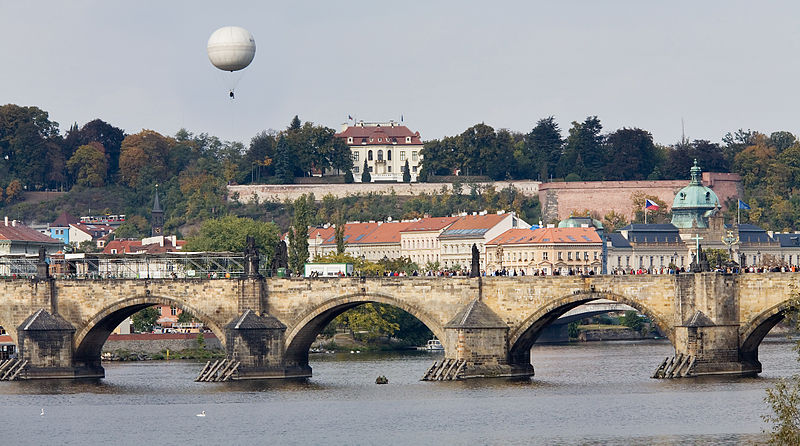
Right now, the French school's students are doing their 'detective work', as the organizing teacher calls it, to understand who Martinů was, and what his connection to Aix was. They are also learning some basic Czech and rehearsing a theatrical piece inspired by Martinů and his life that they will perform while in Prague. Our son's private piano teacher is helping him learn a bit about Martinů through his music, with a lively and challenging piano composition from Borová, his Seven Czech dances (in this case, the 7th dance). The actual 10-day trip to Prague this spring will represent the high point of active learning, where students will gain understanding by crossing the bridge between abstract knowledge and concrete experiences, and during which they will no doubt trace Martinů's steps in Prague a bit, perhaps even crossing some of the same physical bridges as he did. An equivalent learning experience will take place for the Czech students when they come to Aix the following year to see where Martinů lived briefly and composed. While some of the learning on both sides is taking place in English, both groups of students will also be immersed linguistically and culturally within their host families on their respective visits. As our family has so clearly discovered during our French adventure, such immersion is the ultimate active learning experience!
Active learning opportunities in the form of school exchanges and field trips are also available all over the l'Union Européenne (European Union, the French reverse the EU). The EU sponsors cultural bridge opportunities for schools across member states, such as those available under the Comenius Lifelong learning program. From our U.S. perspective, these opportunities seem so cosmopolitan because they involve the crossing of national borders and multiple languages, whereas field trips across similar distances in the U.S. take us at most to another state. But the active learning occurs regardless of where the field trips take students. This year and next year, our boys' school is engaged in Comenius-sponsored bilateral school project with a middle school in Prague. (Details about EU-sponsored Comenius Bilateral school projects are available directly on the EU website for Lifelong learning programs, click here http://ec.europa.eu/education/comenius/school_en.htm and then on the link to bilateral projects.
The subject of the bilateral project between Collège Auguste Mignet in Aix en Provence and Ďáblice middle school in Prague is the Czech composer Boruslav Martinů. He studied and performed music in Prague, and after leaving his homeland en route to the United States, he made a brief visit to Aix, where he composed some music and developed a friendship with Aix composer Darius Milhaud (for whom the Aix music conservatory is named). (Click here for a brief explanation of the project thus far, by the organizing teacher on the French school's website, in French. Click here for my translation, in English. And again here, for the Czech school's announcement of the project, in Czech. ) Martinů thus represents un pont entre deux cultures (a bridge between two cultures), while the bilateral school project itself offers a pedagogical bridge over which the students will make connections between what they are learning about Martinů at school and what they experience in the physical and cultural environment in which he did some of his work. Of course, I see many sociological learning opportunities here as well, as the students will surely begin to recognize that underlying the cultural and linguistic differences are basic social and human qualities that we all share.
Right now, the French school's students are doing their 'detective work', as the organizing teacher calls it, to understand who Martinů was, and what his connection to Aix was. They are also learning some basic Czech and rehearsing a theatrical piece inspired by Martinů and his life that they will perform while in Prague. Our son's private piano teacher is helping him learn a bit about Martinů through his music, with a lively and challenging piano composition from Borová, his Seven Czech dances (in this case, the 7th dance). The actual 10-day trip to Prague this spring will represent the high point of active learning, where students will gain understanding by crossing the bridge between abstract knowledge and concrete experiences, and during which they will no doubt trace Martinů's steps in Prague a bit, perhaps even crossing some of the same physical bridges as he did. An equivalent learning experience will take place for the Czech students when they come to Aix the following year to see where Martinů lived briefly and composed. While some of the learning on both sides is taking place in English, both groups of students will also be immersed linguistically and culturally within their host families on their respective visits. As our family has so clearly discovered during our French adventure, such immersion is the ultimate active learning experience!
| St. Charles Bridge in Prague © Jorge Royan / http://www.royan.com.ar / CC-BY-SA-3.0 under Creative Commons Attribution-Share Alike 3.0 Unported |
Subscribe to:
Posts (Atom)