Showing posts with label education. Show all posts

11 October 2013

Le respect

Because I haven't attended French schools myself and parents are not typically invited to be on school grounds during the school day, there are many everyday classroom protocols that I only know about through my children.  For example, when middle school students enter a classroom, they must stand by their desks and wait until the teacher tells them to sit down.  Likewise, if an administrator such as the principal enters the classroom, even unexpectedly, all of the students must instantly scramble onto their feet to stand beside their desks in a sign of respect for him or her.  And, when raising their hand in response to a teacher's question, students raise their index finger, as if gently pointing up to the ceiling (no frantic U.S. style hand waving here!).

These are markers of le respect that are specific to a culture.  Curiously though, they imply strong deference to authority, in a society where many other social conventions seem to be intended to create social exchanges on a more equal footing.  I've noted earlier how the French offer greetings and farewells in stores, and this is in part I think to create a setting of mutual respect between the seller and the consumer for the potential economic exchange that may take place.  Once, when I was so focused on making sure I got my order right in French at the fanciest bakery in town, I forgot to say bonjour.  The bakery clerk repeated his bonjour to me three times, waiting for me to return it before he would help me with my order.  And there is what I sometimes think of as the kiss-fest that occurs whenever we go to football practice or a game.  I easily faire les bises with at least 20 people, parents, coaches, players, siblings of players, grandparents of players, etc.  It doesn't matter what the person's social or coaching rank is, we make these exchanges as a way to imply a kind of respect for each other as persons, where we acknowledge each other's humanity for just a moment even if we go on to sit or chat with someone else.  Finally, there are the opportunities for the French public to respectfully disagree with their political and economic leaders, by striking and bringing the country to a standstill, if for a moment.  This week the air traffic controllers and local train line staffs took their turn in the South of France.  (I also wrote about the strikes of last October in Les manifestations, Oct. 2012.)

Unfortunately, in some social arenas, authority figures do sometimes use their positions to demand respect from their followers but don't always offer considération (respect) in return.  We see this in politics often, even in democratic societies.  For example, we have the government shut-down in the U.S. brought about by politically powerful people who can't seem to make compromises for the good of everyone (striking is not a privilege for the government, but for its people!), and in France, we have the amazingly sexist behavior of some French MPs (members of parliament) towards their female colleagues ("France's sexist National Assembly", France24blogs, 10/10/2013), and the unfortunate comments by a presidential cabinet member in regards to the Roma population in France (Roms: le Mrap va déposer plainte contre Valls devant le CJR, La Provence, 11 Oct. 2013).  In the educational setting, the rules about respect seem to vary a bit more widely.  In U.S. schools, students are expected to act politely to their teachers and administrators, but standing up in the presence of teachers or shaking their hands is not required, not anymore anyway.  Teachers and administrators themselves must abide carefully by rules governing appropriate personal or physical contact and are expected to be mutually respectful.  In French public schools, the model seems to be be much more authoritarian and the flow of respect is largely from the students towards their teachers.  I hear a lot about verbal berating of students--students are often told what they are doing wrong and very little of what they are doing well--and this week at my sons' school, a teacher reportedly hit a student violently for misbehaving.  Yet, the school year began with the national announcement of a new secular code of conduct for all French students ("School year begins in France with string of reforms," France 24, 4 Sept. 2013).  Codes of conduct are pretty common in U.S. educational institutions, and a few months ago, I reiterated a feminist's call for a broad social code of conduct in everyday life (see La politesse March 2013). Yet, I gather from the cartoon below from a page in my French daily calendar that the question of mutual respect is still a bit of a joke at French schools.  Maybe the new code of conduct should address everyone at school, students and adults alike?

In the Ethics class, on Politeness, a student says to the teacher,
"One stands up when the students enter the classroom!"

19 July 2013

La jeunesse

Two paintings by Agnolo di Cosimo, Firenze, Uffizi, 1540's
One of my favorite lessons in my sociology of family course is on the changing meanings of childhood.  Some argue that children in the past centuries were essentially treated as little adults, contributing to household economies and serving as means by which to solidify family alliances.  Only later when the industrial revolution altered familial functions and roles do we see the emergence of childhood as a special stage of life. Children's ages and feelings may not have changed, but how they are viewed and presented in society has, which is another way of saying that while age may be reflected physically and psychologically, it is also social.  (The images above portray children of the Medici family as small adults.  From our contemporary view, we might guess that these children were chafing in those adult-like outfits and poses.) We also have cultural and class-based variations in our understandings of childhood;  I have learned this week that the French often call adolescence l'âge bête, which conveys the idea that humans are born uncivilized.  It is through childhood and adolescence that they are taught to curb their animal-like natures in order to become productive and upstanding members of society.  In the U.S. we currently have multiple trends, where children are pushed to become little adults and over-achievers, or are seen as capable decision-makers with whom we can reason, or are left to their own devices.  The social understandings of age continue to evolve, as meanings of childhood, of la jeunesse (youth), of young adulthood, and even middle age and old age change, due to economic conditions and changing perceptions of marriage, non-marital sexual activity, parenthood, and longer life spans.

This week I have had further affirmation of how age is a social feature but also an inner state of mind that may not always correspond to the social meaning.  For the past three weeks, I have been part of the first cours intensif de francais (French intensive language course) at the shiny new Alliance Française language school in Aix.  Alongside my Chinese, English, and Spanish classmates, I have been eagerly and diligently working my way through French subjunctives, gerunds, and transitional phrases, just like an eager-to-please first grader in the front row of her classroom.  As a small class, we are all struggling, laughing, and succeeding together, deciphering oral dialogues and correcting the order of double pronouns, pronouncing difficult words so they don't sound like vulgarities (pourtant: pronounce the r, otherwise you get a bad word), learning useful phrases for phone texting, like à + (à plus, which is short for à plus tard, see you later), and ways to describe, or envisager, our dreams for our future.  We take our coffee or tea breaks together and bavarder (chat) a bit.  It seems like we are in the same boat.

But in fact, we are not.  One young classmate has a musical career with a traveling orchestra, while the other two are still students, embarking on post-undergraduate studies in Paris this fall and are in the midst of finding affordable apartments and figuring out bank accounts and cell phones.  I am twice the age of these students, okay...over twice the age, and I am in a completely different life stage.  Just the other day, we took turns selecting discussion questions, and I realized that I chose ones that clearly reflected my current situation as the mother of adolescents, while the students are in intimate relationships.  Learning French, and moving to a new country, yes, we have those things in common, but it is so interesting to realize that one can feel so youthful and so old en même temps!  (at the same time!)   It's not a feeling I often have, as a university and college instructor where I instruct many students the age of my current classmates.  As a temporary student myself though, I guess I feel 21 again, despite my outward appearance and my life stage.   That's what is so confounding, that one can feel much younger (or older) than one's social age.  Fortunately, my classmates don't see my social age as too much of a barrier; we might even go out for drinks next week.

10 July 2013

Avec mention assez bien

Big day in France today as the results of the nation-wide scholastic tests have just been published...publicly.  In June, virtually all middle students, upon completion of troisième (3rd grade, equivalent to U.S. 9th grade), take an exam called le brevet, while the graduating class at lycée (high school) take the baccalauréat, or le bac.  Now all of the results are in, and they are publicly available.  Anyone can see who 'has' his or her brevet or bac, as one says in French, and whether they attained mentions (distinctions) such as assez bien (well-done), in a particular subject.  You can walk up to the school and see the posted list, or apparently you can call the school, or go on the Education Ministry's site, or you can pay to see online, http://www.resultat-exam.fr/examen/resultat-brevet-des-colleges-dnb-professionnel-2013?utm_source=fb&utm_medium=newsfeed&utm_campaign=mmr


All of this is reflective of the distinctions between what is public and private in a given society, a subject I have thought about earlier (see Transparence, April 2013).  In regards to scholastic outcomes, the French are relatively public about whether or not students succeed, even in the classroom where teachers announce grades out loud, whereas in the U.S. the trend has been towards greater privacy.  Today, the old practice of posting university course grades outside one's office door, perhaps by student number rather than name is no longer allowed at most U.S. institutions, nor does one leave final exams lying in a box for students to rife through to find their own.  It may be that we see test outcomes somewhat differently, or that we place different importance on them.  In the U.S., school test results at any level, elementary, secondary, higher education, are largely seen as personal, or individual ones, reflecting a person's intelligence, test-taking ability, successful learning.  Any results that are publicicized are only done so in aggregate form.  And many, if not most, states do not require an exam before one can graduate.  Perhaps in France the terminal exams and the publicizing of the exam results are important because maybe these are a way of publicly accounting for the national educational system's efforts?  After all, everyone takes the same exams on the same days, and the results come out all at once, giving a quick result that the country-at-large can see.  How well are French students doing, how well is the school system doing?  In the U.S. on the other hand, each state has its own version of scholastic tests and its own standards, with few requiring school completion exams, so there is virtually no coordination across states.  While the public may have a loose sense of how well the state educational systems are accomplishing their goals, they have an even vaguer sense of how we are doing on a national level.  For that kind of accounting, we have to look for international comparisons of national educational systems, which is complex on its own for various reasons, and in addition, for the U.S., we have to somehow interpret results for a country with essentially 50 separate educational systems.  In any case, I am certain that there are many personal celebrations going on among the 14/15 year olds, and more so among the 18 year olds in France today, just like there were a few weeks ago among U.S. high school graduates.  For the French who are not celebrating, luckily there are second chances, as one can retake part of the exams in hopes of gaining enough points to attain le bac.

19 June 2013

Europa

Beehives at Mt. Ste Victoire, near Aix en Provence

In my Introduction to Sociology courses, students learn about the levels of society and how these all fit together to comprise what we call the social structure.  I sometimes talk about these as boxes that fit or nest into ever larger ones.  We can start with individuals, the smallest box, but it is the following boxes, where individuals are grouped together, that interest most sociologists.  These are the boxes containing small interpersonal family or friendship groups, and medium ones filled with larger groupings of individuals, like student bodies or employees, and bigger ones with more formalized groups that we call social organizations, such as schools or companies.  Then we have bigger boxes we might call social institutions into which those organizations are grouped, and that we might describe as school systems, or economies, and so on.  These all fit into the biggest box, the one containing all the cultural elements and the structure of a society, and give all of the members therein a shared social identity.  Society is thus the biggest box. 

Last week I had an a-ha moment about an even bigger social box.  I was in Florence, IT, listening to the keynote speech at a European-organized international education conference, about the new Erasmus for All educational and training program planned by the European Union to begin in 2014.  Simultaneously, one of my sons was in Prague, CZ, participating in a European Union-sponsored school exchange program which will eventually be subsumed into this new overarching program.  (I previewed the Comenius school exchange in an earlier post, see Ponts, Feb. 2013.  Here's more about the conference and my paper: Creating Excitement...in Florence, IT, June 2013).  I suddenly realized how interesting this was to be hearing about and participating in closely-coordinated and funded educational activities on a supra-societal level, and I wondered where my U.S. students would place the EU in the nesting box schema above.  For Europeans living in EU member-states, they transcend their own national-social structures and the identities that go with them every day, as they reach into their wallets and pay for something with Euros.  In sharing a currency, that thing that all societies need in order to exchange for goods and services, these people share some important social markers, at the very least, an economic identity.  They are part of their own national box but also fit into a bigger social box that we might call Europa.  Clearly though, the bigger the box, the more complex the social interactions and identities therein.  For example, for his class trip, my son needed Czech currency and not Euros because the Czech Republic is not part of the EU currency union yet is a EU member-state.  And if we look at education as it is being coordinated on the European level, sharing educational ideas, training efforts, philosophies, and resources (the budget for Erasmus for All is 19 billion Euros over 7 years, according to the keynote speaker, Lorenza Venturi) both unites and complicates the social identities of the members.  Sharing a currency is one thing, sharing education is yet another, because education is that essential social tool through which we create and pass down knowledge, values, and norms--all those tangible and intangible pieces of culture.  Individual member-states have their own educational cultures yet through European 'cooperation', a pan-European educational culture is also being created, and with that, a distinctive social identity.  The features of this identity are still evolving, as every member-state and the members therein want to weigh in; see how secular and religious ideas compete for influence in "A More Secular Europe Divided by the Cross" by Andrew Higgins, June 17, 2013, The New York Times.  The situation is different in the U.S., even with our 50 states and their own educational systems, perhaps because the cultural and institutional pieces are quite similar and they all easily fit into a bigger social box called the U.S., and where the knowledge and culture that is being created and disseminated, whether in Washington state or Georgia, has a distinctive American character.  (And this character influences teaching and presentation styles too, which I could not help but note as I heard presenters from the U.S., England, Quebec, the Netherlands, South Africa, Taiwan, and Japan.)  What I'm becoming more and more aware of, particularly through the educational channel, is a transcendent European social identity, that stems from a supra-national entity we call the European Union.  If I think about it in terms of nested boxes, this is a pretty big box, with a fairly loose lid, that currently contains 27 other sets of boxes (or social structures).


25 February 2013

Les boules de neige

Like boules de neige (snowballs) that get bigger and denser the more snow you pack into them, the ski resorts in France are getting more and more crowded in this second week of les vacances scolaires (school holidays). French school 'districts' are divided into three zones (Aix schools fall into zone B), and the school winter and spring holidays are staggered by zone so that holiday locales can adequately meet the domestic demand for accommodations and space. Each year a different zone begins the holiday cycle; last year zone B had the last winter and spring holidays, occurring in mid-March and early May, respectively, while this year zone B starts off the cycle. Unfortunately, we could not get away the first week, so our zone B family's stay at a little 10-room hotel aptly called La boule de neige, in the ski resort at Serre Chevalier, near Briançon, overlaps with a zone A family's, from Lyon. (The Parisians of zone C arrive one week later by which time our kids will be back in school.)

The crowding and the scheduling of the family ski day seems to be especially attuned to mealtimes, which is of course especially French (even if not all that different from family ski days at resorts in other parts of the world). Ski lifts open at 9 here in the southern Alps, and the télésiège (chairlift) and télécabine (gondola) lines are heavy by 10:30, after the leisurely petit déjeuners (breakfasts) with chocolat chauds (hot chocolates) and croissants have been eaten. The activity on the slopes quiets down considerably during the sacrosanct midday mealtime (except at the mountain and village restaurants!), and then again, after 5 pm, when one begins to see bunches of baguettes under the arms of ski parkas in the village. By this time, the last chairlifts stop running and families prepare for goûters and apéros (snacks and cocktails), before the evening meal around 7 or 8 pm.

Interestingly, we've met several adults without kids, French and foreigners alike, who are or were vacationing here at this same time as all of these French families with schoolchildren. If I were an avid skier and a parent without children at home (I am neither), I think I would avoid this particularly crowded time. One would think the accommodations would be cheaper and more widely available, and the village less boisterous (there's a carousel and marching band in ours, and a Wednesday evening super-spectacle complete with torch-bearing skiers and a fireworks display!), while the lines would be virtually non-existent and the snow would be as good and powdery even a few weeks on either side of the school holidays. We were in the Haute Savoie last Easter, outside of the school holiday times and had good snow, very short chairlift lines, and lots of fin de saison (end of ski season) sales on ski gear. (I mentioned this trip in a post in April 2012 called Département 13.). I'm sure the local hotel and restaurant proprietors appreciate the extended and less frenetic holiday times, but for many guests, I suppose part of the charm of alpine skiing is the lively aprés-ski scene. Without the hustle and bustle of vacationing families in the villages, the excitement and energy of the social environment after skiing is likely much lower, weaker, or might we say, softer, just like snowballs made of snow too early or too late in the season.


11 February 2013

Ponts

As  I prepare my online courses for each quarter, I frequently think about ways to engage my students actively.  The emphasis on active learning is especially strong at the community college-level, where more personalized instruction is often possible and learning outcomes are frequently tied to active learning strategies, but I employ such strategies as much as I can at the university level too.  Active learning strategies are essentially a pont (a bridge) between the abstract concepts we teach and the concrete understanding of these.  By engaging learners actively in understanding a concept or procedure or way of thinking, such as through experience, or a project, or experiment, we hope to create higher-order and more independent thinking.  Some of the bridging strategies we employ today are new to higher education, but in other respects, we have long employed active learning strategies in education.  In particular, I am thinking about the field trip, or the school trip.  Such trips offer active, experiential learning that can enhance what has been learned previously in a classroom.  I fashion field trips for some of my online courses, where I ask students to do an independent field observation of social behavior, or for my face-to-face courses when I require service learning or when I have walked students to spaces on campuses to show concretely what sociologists can learn from outside stained glass windows (in my sociology of religion course) or from library-provided research databases (in my introduction to sociology course).  Field trips are of course common in the U.S. at the compulsory educational level.  I for one have many memories of school field trips, such as the one to plant fir seedlings on the Olympic Peninsula in 6th grade, or another one in high school, to Seattle (the big city!) to perform in a marching band competition.
 
Active learning opportunities in the form of school exchanges and field trips are also available all over the l'Union Européenne (European Union, the French reverse the EU).  The EU sponsors cultural bridge opportunities for schools across member states, such as those available under the Comenius Lifelong learning program.  From our U.S. perspective, these opportunities seem so cosmopolitan because they involve the crossing of national borders and multiple languages, whereas field trips across similar distances in the U.S. take us at most to another state.  But the active learning occurs regardless of where the field trips take students.  This year and next year, our boys' school is engaged in Comenius-sponsored bilateral school project with a middle school in Prague.  (Details about EU-sponsored Comenius Bilateral school projects are available directly on the EU website for Lifelong learning programs, click here  http://ec.europa.eu/education/comenius/school_en.htm  and then on the link to bilateral projects.)  Without explicitly say so, these bilateral projects are clearly meant to offer experiential and active learning opportunities through language learning, through the study of a theme of mutual interest, and through cultural exchange.  The project documentation also mentions the goal of 'enhancing the European dimension of education.' 

The subject of the bilateral project between Collège Auguste Mignet in Aix en Provence and Ďáblice middle school in Prague is the Czech composer Boruslav Martinů.  He studied and performed music in Prague, and after leaving his homeland en route to the United States, he made a brief visit to Aix, where he composed some music and developed a friendship with Aix composer Darius Milhaud (for whom the Aix music conservatory is named).  (Click here for a brief explanation of the project thus far, by the organizing teacher on the French school's website, in French.  Click here for my translation, in English.  And again here, for the Czech school's announcement of the project, in Czech. )  Martinů thus represents un pont entre deux cultures (a bridge between two cultures), while the bilateral school project itself offers a pedagogical bridge over which the students will make connections between what they are learning about Martinů at school and what they experience in the physical and cultural environment in which he did some of his work.  Of course, I see many sociological learning opportunities here as well, as the students will surely begin to recognize that underlying the cultural and linguistic differences are basic social and human qualities that we all share.

Right now, the French school's students are doing their 'detective work', as the organizing teacher calls it, to understand who Martinů was, and what his connection to Aix was.  They are also learning some basic Czech and rehearsing a theatrical piece inspired by Martinů and his life that they will perform while in Prague.  Our son's private piano teacher is helping him learn a bit about Martinů through his music, with a lively and challenging piano composition from Borová, his Seven Czech dances (in this case, the 7th dance).  The actual 10-day trip to Prague this spring will represent the high point of active learning, where students will gain understanding by crossing the bridge between abstract knowledge and concrete experiences, and during which they will no doubt trace Martinů's steps in Prague a bit, perhaps even crossing some of the same physical bridges as he did.  An equivalent learning experience will take place for the Czech students when they come to Aix the following year to see where Martinů lived briefly and composed.  While some of the learning on both sides is taking place in English, both groups of students will also be immersed linguistically and culturally within their host families on their respective visits.  As our family has so clearly discovered during our French adventure, such immersion is the ultimate active learning experience!

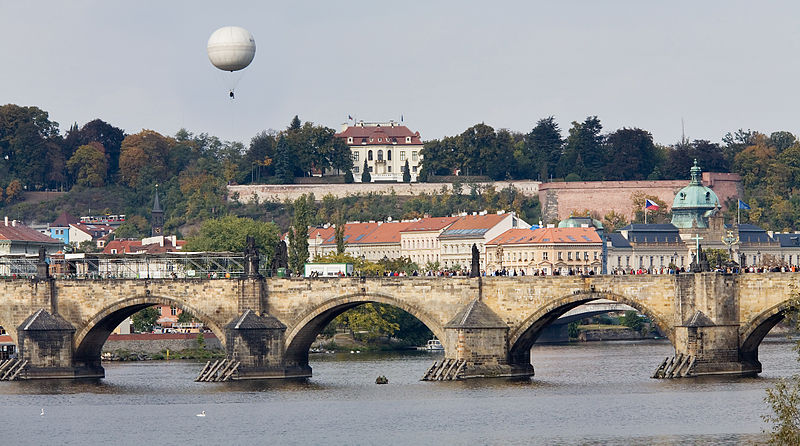
St. Charles Bridge in Prague © Jorge Royan / http://www.royan.com.arCC-BY-SA-3.0 under   Creative Commons Attribution-Share Alike 3.0 Unported

31 January 2013

La vie familiale

The U.S. academic and mainstream presses have been highlighting the significant social class differences in how Americans experience family life, and the distinctive outcomes that such experiences bring.  What we are seeing is twofold.  The middle is falling out of the middle class, in that the median income of the middle class is falling and the middle class share of the nation's wealth is declining (PEW Research, August 2012. "[video] Lost Decade of the Middle Class." Social and Demographic Trends).  As the the middle thins out, we are noting increasingly disparate family patterns at each end, in terms of coupling, childrearing, and life chances.  Families in the upper middle class and above are increasingly more likely to be led by married couples, and these families contain children who receive a great deal of attention and enrichment in their lives, thanks to the opportunities afforded by two incomes and the presence of two educated adults.  Families on the lower end of the social class spectrum, those slipping out of that shrinking middle section and below, are increasingly much less likely to consist of two parent households or to be created out of marriage, and the parents in such families are less well-educated, work in relatively unstable and low-paying service occupations, and struggle to offer children adequate educations let alone the chances to develop themselves in other ways.  A particularly poignant portrait of this is provided in Jason DeParle's article from this past summer (July 14, 2012, "Two Classes, Divided by 'I do'." The New York Times.).  The article collection that I use for my sociology of family courses (Public and Private Families A Reader, 7th edition, edited by Andrew Cherlin, 2013) reflects this shift as well, as there is a recurrent focus on the social class divide in family experience in many of the articles in the newest edition.

In France, distinctive family patterns by class are not immediately obvious.  People generally seem to dress well and eat well here, and la vie familiale (family life) seems relatively similar across social class.  Sure, there is a high divorce rate here too, and unmarried childbearing is not uncommon, but it occurs at the top and bottom (witness France's president!), and families with children, of all class backgrounds and parental structures, can and do receive broad financial support in France in the form of educational, food and other kinds of public subsidies (not to mention tax breaks for having kids in school).  This modulates the living standards and to some extent, life chances, giving a more uniform experience across the social classes.  Even children of single mothers or parents with relatively low-paying jobs seem able to outfit themselves in the latest skater gear, and  participate in extracurricular activities, purchase books, and may go on to public university (if they complete their compulsory educations, a spot is guaranteed), something we simply don't see across the board for U.S. children.  In our own experience here, we note that the soccer club fees we pay in France for one adolescent son are barely 10% of what we paid in Seattle, and the département (administrative region) in which we live provides booklets of vouchers for every middle school child which further reduce sports participation fees and the prices of tickets to movies or cultural performances (pictured above).  And then there is that high-quality, centralized public school system that most French schoolchildren attend, complete with a substantial four-course meal (the price of which can also be reduced), in contrast to the U.S. where school quality and school food vary greatly by state and community, further accentuating any class disadvantages that already exist. 

Yet, the French middle has also hollowed out a bit (see short video The Globe and Mail, Feb. 22, 2012, "Tough Choices for France's Middle Class"), and the 'social elevator' that was powered by earlier, more generous social programs and that created the attendant social leveling of the previous decades has slowed down during the current period of economic stagnation in France and elsewhere in Europe.  Will distinctive class patterns and outcomes become more evident among French families as a result?  The data will tell.  On the other hand, there are probably greater distinctions among French families than I can recognize, struggling as I am as a foreigner to read the social cues and understand the conversations around me.  I do sense the surprise of local acquaintances when we mention a recent trip to Paris, or the gently raised eyebrows of the staff when I pay our children's sport fees in full and before the deadline.  And I still think back to that conversation with my former driving school teacher during one of her cigarette breaks (I mentioned this also in a post last summer, Je ne sais quo ) when she emphatically pointed out the rigidity of the French class system, the fact that someone of the French lawyer 'class' would have virtually no reason ever to socially interact with or speak to someone like her.  By extension then, I have to suspect that as her children experience life from a similar social position and under challenging economic conditions to boot, class privilege and oppression will play an ever greater role in France too, in accentuating existing social patterns and determining family and personal outcomes.

03 September 2011

La rentrée


The excitement is building, in our apartment as well as around Aix, as la rentrée is nearly upon us. That's 'back to school' in American parlance. The school supply aisles at Carrefour and Monoprix are picked through by now (Carrefour is like Fred Meyer, and Monoprix is rather like a smaller Macy's, only with a grocery store). Our French neighbor in the States warned us about visiting Carrefour this weekend; we had to do some shopping last night anyway, and we were amused by the sign that said the store would be open on Sunday as an exception (but we were not amused by the long lines...).

Earlier this week, Saku went through his school supplies and practiced writing his address with a fountain pen, and Jori figured out how to use his calculator once he realized that annuler means to cancel. I mentioned the school supply list in my first post from Aix, worrying about it a bit. I then realized after translating it, I could make a go of it. We realized we needed help when we got to the paper and notebooks, so I enlisted the help of my local friend's daughter who's a few years older, to help us get the correct paper and other essentials we didn't know about, like fountain pens and a planner. The photo shows the supplies purchased for one boy. The full cost was easily several hundred dollars (for two students). We still have the school lunch to pay for, and I'm not sure what else.  While I can't compare the cost adequately to U.S. public middle school/junior high school, I feel like we have just put in a fair amount of money to attend public school. Aside from our extra costs associated with coming here in May for a week to take the entrance exams, I wonder how French families manage?

I poked around a bit on the national education sites, since the boys' school, Collège Mignet, is a French public school. (In fact, it was previously a high school, Lycèe Mignet, and Cezanne was its most famous student!). Anyway, French families can apply for financial assistance for public school, and it looks like it is much more broadly available to families and more broadly used. In a way, I think it's like a tax credit, only in the form of cash vouchers. I'm going to investigate this further as I am curious.*

What will la rentree look like for us? We know that Monday will be the first day of school for the 6th graders, all of whom will be new to the school. The kids attend from 9-5, and then Tuesday and Wednesday are introductory days for the upper grades (these are 5th, 4th and 3rd grades; in France, the classes are labeled in descending order so that 1st grade is our 12th grade). So, our boys attend one day, get their schedules and their books, find their way around the school, and try out the school lunch (the menus are impressive from last spring), and then they have two days off. School begins in earnest on Thursday, 8 September, for everyone. We'll surely have more to share after that.

Happy Labor Day, U.S. friends!  (Some of you have started school already.)

*A year later, Aug. 2012: There is indeed an allowance for families with incomes below a certain level: http://www.connexionfrance.com/Allocation-rentree-scolaire-Hollande-payment-14007-view-article.html