Showing posts with label music. Show all posts

11 February 2013

Ponts

As  I prepare my online courses for each quarter, I frequently think about ways to engage my students actively.  The emphasis on active learning is especially strong at the community college-level, where more personalized instruction is often possible and learning outcomes are frequently tied to active learning strategies, but I employ such strategies as much as I can at the university level too.  Active learning strategies are essentially a pont (a bridge) between the abstract concepts we teach and the concrete understanding of these.  By engaging learners actively in understanding a concept or procedure or way of thinking, such as through experience, or a project, or experiment, we hope to create higher-order and more independent thinking.  Some of the bridging strategies we employ today are new to higher education, but in other respects, we have long employed active learning strategies in education.  In particular, I am thinking about the field trip, or the school trip.  Such trips offer active, experiential learning that can enhance what has been learned previously in a classroom.  I fashion field trips for some of my online courses, where I ask students to do an independent field observation of social behavior, or for my face-to-face courses when I require service learning or when I have walked students to spaces on campuses to show concretely what sociologists can learn from outside stained glass windows (in my sociology of religion course) or from library-provided research databases (in my introduction to sociology course).  Field trips are of course common in the U.S. at the compulsory educational level.  I for one have many memories of school field trips, such as the one to plant fir seedlings on the Olympic Peninsula in 6th grade, or another one in high school, to Seattle (the big city!) to perform in a marching band competition.
 
Active learning opportunities in the form of school exchanges and field trips are also available all over the l'Union Européenne (European Union, the French reverse the EU).  The EU sponsors cultural bridge opportunities for schools across member states, such as those available under the Comenius Lifelong learning program.  From our U.S. perspective, these opportunities seem so cosmopolitan because they involve the crossing of national borders and multiple languages, whereas field trips across similar distances in the U.S. take us at most to another state.  But the active learning occurs regardless of where the field trips take students.  This year and next year, our boys' school is engaged in Comenius-sponsored bilateral school project with a middle school in Prague.  (Details about EU-sponsored Comenius Bilateral school projects are available directly on the EU website for Lifelong learning programs, click here  http://ec.europa.eu/education/comenius/school_en.htm  and then on the link to bilateral projects.)  Without explicitly say so, these bilateral projects are clearly meant to offer experiential and active learning opportunities through language learning, through the study of a theme of mutual interest, and through cultural exchange.  The project documentation also mentions the goal of 'enhancing the European dimension of education.' 

The subject of the bilateral project between Collège Auguste Mignet in Aix en Provence and Ďáblice middle school in Prague is the Czech composer Boruslav Martinů.  He studied and performed music in Prague, and after leaving his homeland en route to the United States, he made a brief visit to Aix, where he composed some music and developed a friendship with Aix composer Darius Milhaud (for whom the Aix music conservatory is named).  (Click here for a brief explanation of the project thus far, by the organizing teacher on the French school's website, in French.  Click here for my translation, in English.  And again here, for the Czech school's announcement of the project, in Czech. )  Martinů thus represents un pont entre deux cultures (a bridge between two cultures), while the bilateral school project itself offers a pedagogical bridge over which the students will make connections between what they are learning about Martinů at school and what they experience in the physical and cultural environment in which he did some of his work.  Of course, I see many sociological learning opportunities here as well, as the students will surely begin to recognize that underlying the cultural and linguistic differences are basic social and human qualities that we all share.

Right now, the French school's students are doing their 'detective work', as the organizing teacher calls it, to understand who Martinů was, and what his connection to Aix was.  They are also learning some basic Czech and rehearsing a theatrical piece inspired by Martinů and his life that they will perform while in Prague.  Our son's private piano teacher is helping him learn a bit about Martinů through his music, with a lively and challenging piano composition from Borová, his Seven Czech dances (in this case, the 7th dance).  The actual 10-day trip to Prague this spring will represent the high point of active learning, where students will gain understanding by crossing the bridge between abstract knowledge and concrete experiences, and during which they will no doubt trace Martinů's steps in Prague a bit, perhaps even crossing some of the same physical bridges as he did.  An equivalent learning experience will take place for the Czech students when they come to Aix the following year to see where Martinů lived briefly and composed.  While some of the learning on both sides is taking place in English, both groups of students will also be immersed linguistically and culturally within their host families on their respective visits.  As our family has so clearly discovered during our French adventure, such immersion is the ultimate active learning experience!
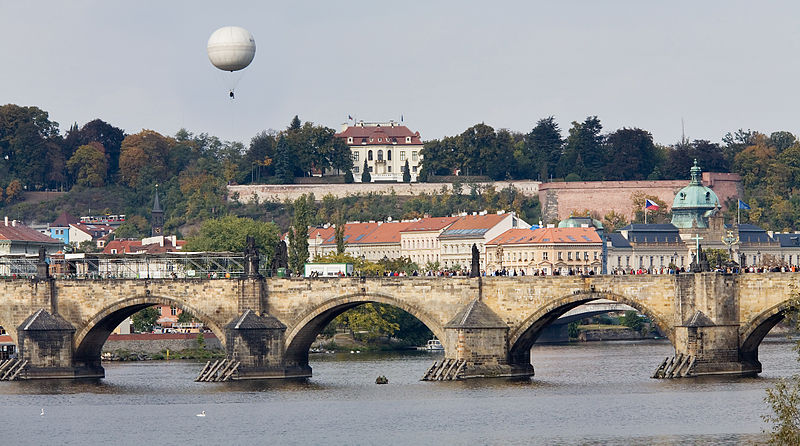
St. Charles Bridge in Prague © Jorge Royan / http://www.royan.com.arCC-BY-SA-3.0 under   Creative Commons Attribution-Share Alike 3.0 Unported

24 June 2012

L'estival

You might think that in a place with nearly endless sunshine and light, summer's arrival would be rather unremarkable.  In fact, the rituals associated with the start of l'estival (summer) are quite pronounced here, in the South of France.  It seems we spent all weekend welcoming the Provençal sun in its new season.

First, to celebrate the summer solstice, we enjoyed la fête de la musique (the celebration of music) on Thursday, June 21.  The tradition of free music in the streets until the wee hours of the morning is actually relatively young, 30 years old, but it is widespread throughout France.  Aix's fête (party) is well-known in Provence because there are so many stages set up throughout the many squares, so the music-lover has much to choose from, from the French pop, rock, blues, classical, reggae-style, orchestral, and so on.  Aix also has more reliable weather (some fêtes were canceled last Thursday due to bad weather in some more northerly French cities).  There were thousands of people in Aix on Thursday, more than we've ever seen, and of all ages, walking around listening to all kinds of music, drinking wine or beer, and occasionally the harder stuff.  Everyone warned us that the crowd gets a little crazy after 9 pm when the alcohol kicks in among the younger set and that there would be bottles and trash everywhere the next morning.  We didn't encounter anything too wild when we turned in after 11 pm, although the pulsating bass beat from the rock venue was audible until after 2 am.  Surprisingly, we found the stages largely disassembled and stacked for removal and the streets cleaned when we and the rest of Aix groggily wandered out to school and work the next morning.

On Saturday, we headed à la plage (to the beach) to La Couronne to celebrate a family birthday, and for many around us, it was no doubt the first visit to the beach for the summer.  Going to the beach is a true rite of summer here, and after some trial runs last summer and twice this spring (one visit to introduce the Med to my sister's family and another with the football team families), we are getting the drill down, especially for the late afternoon/dinner time beach outing.  The picnics at any time can be quite elaborate (salads and main courses and of course wine) as is the equipment (special beach blanket, cutlery, maybe even a table, or a sun shade of some sort).

Unexpectedly, I also got my midsummer bonfire on Saturday night after our beach visit, as Aix closed its main street again, this time for Les feux de la St. Jean (St. John's fire).  A bonfire in honor of St. John is traditional in Finland on midsummer also, a tradition which I have enjoyed many times, and it appears to be a re-created Provencal tradition as well.  The effect was a little different here though, as the bonfire was built just adjacent to the famous Rotonde fountain, on a city street, rather than on a northern lake, and the French pompiers (firefighters) were all ready with their fire hoses uncoiled and fire uniforms on in case the bonfire got out of control and spread to the dry trees and other vegetation nearby.  Not only that, the chaleur (heat) from the bonfire was doubly intense because the air itself was already so warm, and the Provençal dancers and musicians in their costumes carefully danced as far away from the heat as they could.

And finally, we marked the end of school and the end of sports' seasons this weekend.  Because of exam schedules, our boys effectively finished school on Friday, and both boys' sports clubs had grand fêtes (big club-wide parties) today.  The football club party that I attended for over 6 hours today (nothing happens quickly here) involved les apéros (appetizers and cocktails), a barbecue with sausages, chicken, tabouli, pasta salad, capped by the big event, the concours de boules (boules competition).  Boules is a very popular summer game here,  although I was told that hard-core players play year round.  It resembles the Italian bocce ball game and lawn bowling.  Nearly every family had brought a sacoche boules (a boules bag containing 3 boules each, an assortment pictured here), and there were enough players of all ages that I counted 14 games taking place simultaneously on the gravel soccer pitch with teams of 2 playing against each other, all in the intense sunlight.  This game is taken quite seriously; the points were carefully tallied between each set, with careful protocols governing who threw when, and afterwards, everyone shook hands.

I never thought welcoming summer could be so demanding or that it would be quite so important here.  But, l'été (another word for summer) signifies an extended time of leisure for the French and it does make sense that such a season would be welcomed with great fanfare and rituals, even in places where sunshine is a regular occurrence.  We are still trying to get into the French and Provençal seasonal rhythms ourselves, but the rituals we participated in this past weekend, the imminent arrival of summer guests, and a week's vacation in July should help us move right along.

04 September 2011

Pianos Libres


One way that sociologists think about the social world and our behavior in it is to see the social interactions all as a series of performances.  We perform according to the social roles we have in various contexts and based upon the cues we receive as we interact with others in those contexts.  Many social performances are subtle ones, that we perform as family members or friends, while some of the performances may be more obvious, like the ones I put on when I teach a course to students.  Each time I walk into a classroom or log on to my online course, I become a teacher, which comes with specific behavioral expectations and rules and expertise.  I create a performance and interact with my students in ways that are appropriate to the physical or virtual classroom environment.  My students also perform within the classroom context, as they are expected to engage with and master the information and ideas I teach them.

At the moment, our family is involved in many overt social performances daily, as foreigners with limited language skills, and the French around us react in all kinds of ways; some switch to English automatically, eagerly or grudgingly, others speak French more slowly, while yet others freeze up or roll their eyes and give up.  This past weekend, Jori took on several social roles that were new to him and that seemed to transcend his current identity as foreigner.  The first such social role came about because of a lovely music festival in Aix this past week (25. Aug.-3. Sept.) called Musique dans la rue (Music in the street). Just a short distance from our apartment, at a small, ancient square called Place d'Albertas, classical, jazz, and other kinds of musicians had been performing in the open, each night, in 30 minute slots.  They rotated to other locations throughout Aix in the same evening, and we caught a few amazing musical performances, just steps from our building's front door.  On Saturday, the 3rd of September, each of the locations had grand pianos set up for the public to use for free, Pianos Libre.  We cajoled Jori into performing at the square twice in the morning, and he played a piece he was learning in Seattle before we left, El Guitarrista de Linares ~ The Spanish Guitar, by W.T. Sky Garcia, to the utter amazement of the people passing by, and then, Clocks, by Coldplay. (See photo above, and some awkwardly filmed video by his inexperienced camera crew, on youtube:  http://www.youtube.com/watch?v=7KYKDumoOjQ . Later, as we were walking to our car to take care of some errands, we came across another piano at La Rotonde (near the famous old fountain), and Jori repeated with Clocks again (see below, and on youtube: http://www.youtube.com/watch?v=CC0ppIA4FCA ) .  He was so nervous each time, as he had never played in front of so many strangers before, but with a little encouragement (well, bribery), he did it.  Tourists and locals alike were photographing him, and one man said, 'Wow, he's just a junior high kid (un collégian)!'.  What an opportunity, to perform, in public, outdoors, both in an ancient square and in a main thoroughfare, with amazing acoustics, on a grand piano!  (Especially since he has not been able to get his hands on a keyboard for weeks.)  It was very exciting, and it gave Jori the opportunity to try on the social role of musician, or street musician.  It's something he's been thinking about since we moved here, as a way to earn some pocket money (!). Trying out the street musician role, he discovered that you need a broad repertoire and good composure.


Later in the day, Jori became a sought-after athletic prospect.  We attended a sports/activities fair just south of the center of town, to gather information about soccer, football, and swimming, natation, opportunities for the boys.  (I'll write later about our efforts to find a suitable football club for Saku.)  As we were making inquiries for Jori about the swim test for the swim team, a rugby coach approached us and asked if Jori might be interested in playing rugby for his U12-U13 team.  The coach was very intrigued by Jori's size.  We duly took the information about practices, and then attended the swimming tryout.  There, the water polo coach approached us for the same reason, to see if Jori might be interested in playing for him!  Jori, the athletic recruit, in his second new social role, will check out the rugby and swimming opportunities this week, to see which activity he will pursue. 

Starting tomorrow, Jori will perform in his third new social role, along with his brother, as they become middle school students.  This social role is fraught with a bit of anxiety in the beginning, of course, as it would be for any new middle school student.  Middle school comes with new behavioral expectations (that is, performances) and even a new vocabulary, regardless of where the school is located.  In that sense, the experiences that Jori and Saku will have this week as new sixth graders at Collège Mignet are not going to be so different from those that their friends will have back home, as they too begin middle schools, in Seattle.  It will be interesting to compare notes.