Showing posts with label school. Show all posts

11 October 2013

Le respect

Because I haven't attended French schools myself and parents are not typically invited to be on school grounds during the school day, there are many everyday classroom protocols that I only know about through my children.  For example, when middle school students enter a classroom, they must stand by their desks and wait until the teacher tells them to sit down.  Likewise, if an administrator such as the principal enters the classroom, even unexpectedly, all of the students must instantly scramble onto their feet to stand beside their desks in a sign of respect for him or her.  And, when raising their hand in response to a teacher's question, students raise their index finger, as if gently pointing up to the ceiling (no frantic U.S. style hand waving here!).

These are markers of le respect that are specific to a culture.  Curiously though, they imply strong deference to authority, in a society where many other social conventions seem to be intended to create social exchanges on a more equal footing.  I've noted earlier how the French offer greetings and farewells in stores, and this is in part I think to create a setting of mutual respect between the seller and the consumer for the potential economic exchange that may take place.  Once, when I was so focused on making sure I got my order right in French at the fanciest bakery in town, I forgot to say bonjour.  The bakery clerk repeated his bonjour to me three times, waiting for me to return it before he would help me with my order.  And there is what I sometimes think of as the kiss-fest that occurs whenever we go to football practice or a game.  I easily faire les bises with at least 20 people, parents, coaches, players, siblings of players, grandparents of players, etc.  It doesn't matter what the person's social or coaching rank is, we make these exchanges as a way to imply a kind of respect for each other as persons, where we acknowledge each other's humanity for just a moment even if we go on to sit or chat with someone else.  Finally, there are the opportunities for the French public to respectfully disagree with their political and economic leaders, by striking and bringing the country to a standstill, if for a moment.  This week the air traffic controllers and local train line staffs took their turn in the South of France.  (I also wrote about the strikes of last October in Les manifestations, Oct. 2012.)

Unfortunately, in some social arenas, authority figures do sometimes use their positions to demand respect from their followers but don't always offer considération (respect) in return.  We see this in politics often, even in democratic societies.  For example, we have the government shut-down in the U.S. brought about by politically powerful people who can't seem to make compromises for the good of everyone (striking is not a privilege for the government, but for its people!), and in France, we have the amazingly sexist behavior of some French MPs (members of parliament) towards their female colleagues ("France's sexist National Assembly", France24blogs, 10/10/2013), and the unfortunate comments by a presidential cabinet member in regards to the Roma population in France (Roms: le Mrap va déposer plainte contre Valls devant le CJR, La Provence, 11 Oct. 2013).  In the educational setting, the rules about respect seem to vary a bit more widely.  In U.S. schools, students are expected to act politely to their teachers and administrators, but standing up in the presence of teachers or shaking their hands is not required, not anymore anyway.  Teachers and administrators themselves must abide carefully by rules governing appropriate personal or physical contact and are expected to be mutually respectful.  In French public schools, the model seems to be be much more authoritarian and the flow of respect is largely from the students towards their teachers.  I hear a lot about verbal berating of students--students are often told what they are doing wrong and very little of what they are doing well--and this week at my sons' school, a teacher reportedly hit a student violently for misbehaving.  Yet, the school year began with the national announcement of a new secular code of conduct for all French students ("School year begins in France with string of reforms," France 24, 4 Sept. 2013).  Codes of conduct are pretty common in U.S. educational institutions, and a few months ago, I reiterated a feminist's call for a broad social code of conduct in everyday life (see La politesse March 2013). Yet, I gather from the cartoon below from a page in my French daily calendar that the question of mutual respect is still a bit of a joke at French schools.  Maybe the new code of conduct should address everyone at school, students and adults alike?

In the Ethics class, on Politeness, a student says to the teacher,
"One stands up when the students enter the classroom!"

10 July 2013

Avec mention assez bien

Big day in France today as the results of the nation-wide scholastic tests have just been published...publicly.  In June, virtually all middle students, upon completion of troisième (3rd grade, equivalent to U.S. 9th grade), take an exam called le brevet, while the graduating class at lycée (high school) take the baccalauréat, or le bac.  Now all of the results are in, and they are publicly available.  Anyone can see who 'has' his or her brevet or bac, as one says in French, and whether they attained mentions (distinctions) such as assez bien (well-done), in a particular subject.  You can walk up to the school and see the posted list, or apparently you can call the school, or go on the Education Ministry's site, or you can pay to see online, http://www.resultat-exam.fr/examen/resultat-brevet-des-colleges-dnb-professionnel-2013?utm_source=fb&utm_medium=newsfeed&utm_campaign=mmr


All of this is reflective of the distinctions between what is public and private in a given society, a subject I have thought about earlier (see Transparence, April 2013).  In regards to scholastic outcomes, the French are relatively public about whether or not students succeed, even in the classroom where teachers announce grades out loud, whereas in the U.S. the trend has been towards greater privacy.  Today, the old practice of posting university course grades outside one's office door, perhaps by student number rather than name is no longer allowed at most U.S. institutions, nor does one leave final exams lying in a box for students to rife through to find their own.  It may be that we see test outcomes somewhat differently, or that we place different importance on them.  In the U.S., school test results at any level, elementary, secondary, higher education, are largely seen as personal, or individual ones, reflecting a person's intelligence, test-taking ability, successful learning.  Any results that are publicicized are only done so in aggregate form.  And many, if not most, states do not require an exam before one can graduate.  Perhaps in France the terminal exams and the publicizing of the exam results are important because maybe these are a way of publicly accounting for the national educational system's efforts?  After all, everyone takes the same exams on the same days, and the results come out all at once, giving a quick result that the country-at-large can see.  How well are French students doing, how well is the school system doing?  In the U.S. on the other hand, each state has its own version of scholastic tests and its own standards, with few requiring school completion exams, so there is virtually no coordination across states.  While the public may have a loose sense of how well the state educational systems are accomplishing their goals, they have an even vaguer sense of how we are doing on a national level.  For that kind of accounting, we have to look for international comparisons of national educational systems, which is complex on its own for various reasons, and in addition, for the U.S., we have to somehow interpret results for a country with essentially 50 separate educational systems.  In any case, I am certain that there are many personal celebrations going on among the 14/15 year olds, and more so among the 18 year olds in France today, just like there were a few weeks ago among U.S. high school graduates.  For the French who are not celebrating, luckily there are second chances, as one can retake part of the exams in hopes of gaining enough points to attain le bac.

08 May 2013

Contentement

In a talk that I gave at the local Institute for American Universities earlier this afternoon about how the French spend their time, I also summarized French economist Claudia Senik's argument about why the French seem to be less happy or satisfied with their lives compared to others.  She blames in part the authoritarian and rigid French school system for creating citizens who lack the self-confidence and the contentement (contentment or satisfaction) that one might expect in a country with so many wonderful attributes.  (See Claudia Senik's homepage here, or click here for a direct link to her paper The French Unhappiness Puzzle, Working Paper, 2012.)  My family's limited experience with the school system, at its middle school level, suggests that the system is firmly focused on staying within the lines and structure of the nationally established curriculum (this feels especially true in the maths and sciences), and that the teaching and learning within the system is generally not very creative or active or nurturing.  At first glance, it's hard to say if such schooling could lead to broadly-experienced passivity and pessimism among adults.  

I can say that I see more and more how a centrally-organized society uses its national school system to impart broader social values and practices to its emerging young adults.  This process begins early, at the crèches and maternelles (nursery and preschools) where very young French children, from ages 2 and 3, spend hours away from home in the care of others, learning how to sit patiently and how to eat meals like little grown-ups.  It is the recounting of this by some expatriate foreign mothers that has caught the attention especially of the American and English reading public. (See my discussion of one such book in Encadrement February 2012.) 

This week I had another revelation of how the school system may pass on social values and skills.  Faithful readers may recall that just over a year ago I embarked on the painful and expensive process of acquiring a French driver's license (See A is for Autoecole, April 2012).  For weeks, I grumbled about the ridiculously tricky theory questions that had more than one answer and the authoritarian teaching styles of the driving instructors.  Now I have learned that as 2nd year middle schoolers (French 5th graders), my twin sons will be taking the ASSR1 test this month, while students two years ahead of them will take the ASSR2.  The ASSR's are exams offered by the Education Sécurité Routière (Road Safety Education) arm of the National Ministry of Education to middle school-aged French kids to test them about their knowledge of the appropriate behaviors in shared traffic situations.  The parent representative of our boys' class suggested that these exams will be beneficial for the kids when they begin riding motor scooters and eventually prepare for their automobile driver's licenses.  Learning the rules of the road at age 13 is not a bad idea, particularly given the new interest among my boys and their classmates in skating around the busy streets in town on skateboards and longboards.  However, I was amazed to discover after one son took some practice exams on the traffic safety education website, that these were really quite similar to the practice driving theory exams I had taken last spring, right down to the tricky questioning.  So, I think I now understand better why I felt out of my element in driving school; it wasn't just the language.  By the time most French turn 18 or start driving school in earnest, they have the French-style examination drill down, from years of practice: they know what to expect in terms of testing methodologies and teaching styles, they know that it won't be easy to pass the exams the first time, and they know if they don't pass, everyone else is going to know about it.  These students were simply better prepared for the process and its potential outcomes.  And, it might not be such a big leap to consider the possibility that these same students may feel less satisfied or less sure of themselves later in life, when social scientists come along asking them to assess their personal happiness.  Social institutions, such as political and school systems, do have that kind of influence; some may empower their members, with the right to vote, for example, while other institutions may limit their members, say by stifling their intellectual creativity.  Senik's thinking about the French school system may be on the right track after all.

Various wheeled modes of transportation parked on the landing below our apartment

11 February 2013

Ponts

As  I prepare my online courses for each quarter, I frequently think about ways to engage my students actively.  The emphasis on active learning is especially strong at the community college-level, where more personalized instruction is often possible and learning outcomes are frequently tied to active learning strategies, but I employ such strategies as much as I can at the university level too.  Active learning strategies are essentially a pont (a bridge) between the abstract concepts we teach and the concrete understanding of these.  By engaging learners actively in understanding a concept or procedure or way of thinking, such as through experience, or a project, or experiment, we hope to create higher-order and more independent thinking.  Some of the bridging strategies we employ today are new to higher education, but in other respects, we have long employed active learning strategies in education.  In particular, I am thinking about the field trip, or the school trip.  Such trips offer active, experiential learning that can enhance what has been learned previously in a classroom.  I fashion field trips for some of my online courses, where I ask students to do an independent field observation of social behavior, or for my face-to-face courses when I require service learning or when I have walked students to spaces on campuses to show concretely what sociologists can learn from outside stained glass windows (in my sociology of religion course) or from library-provided research databases (in my introduction to sociology course).  Field trips are of course common in the U.S. at the compulsory educational level.  I for one have many memories of school field trips, such as the one to plant fir seedlings on the Olympic Peninsula in 6th grade, or another one in high school, to Seattle (the big city!) to perform in a marching band competition.
 
Active learning opportunities in the form of school exchanges and field trips are also available all over the l'Union Européenne (European Union, the French reverse the EU).  The EU sponsors cultural bridge opportunities for schools across member states, such as those available under the Comenius Lifelong learning program.  From our U.S. perspective, these opportunities seem so cosmopolitan because they involve the crossing of national borders and multiple languages, whereas field trips across similar distances in the U.S. take us at most to another state.  But the active learning occurs regardless of where the field trips take students.  This year and next year, our boys' school is engaged in Comenius-sponsored bilateral school project with a middle school in Prague.  (Details about EU-sponsored Comenius Bilateral school projects are available directly on the EU website for Lifelong learning programs, click here  http://ec.europa.eu/education/comenius/school_en.htm  and then on the link to bilateral projects.)  Without explicitly say so, these bilateral projects are clearly meant to offer experiential and active learning opportunities through language learning, through the study of a theme of mutual interest, and through cultural exchange.  The project documentation also mentions the goal of 'enhancing the European dimension of education.' 

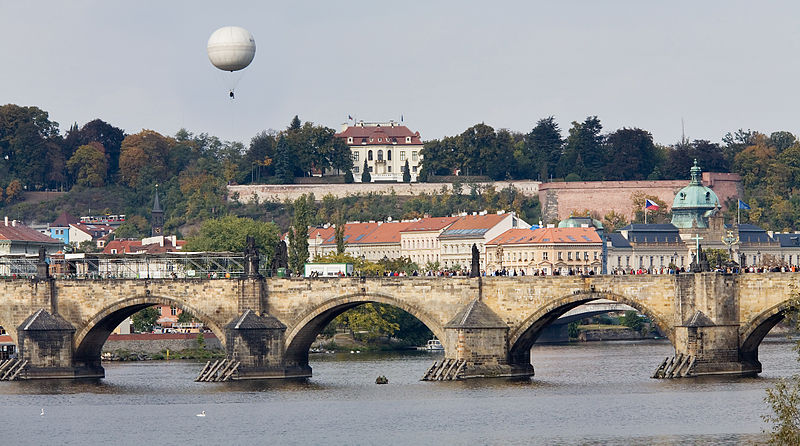
The subject of the bilateral project between Collège Auguste Mignet in Aix en Provence and Ďáblice middle school in Prague is the Czech composer Boruslav Martinů.  He studied and performed music in Prague, and after leaving his homeland en route to the United States, he made a brief visit to Aix, where he composed some music and developed a friendship with Aix composer Darius Milhaud (for whom the Aix music conservatory is named).  (Click here for a brief explanation of the project thus far, by the organizing teacher on the French school's website, in French.  Click here for my translation, in English.  And again here, for the Czech school's announcement of the project, in Czech. )  Martinů thus represents un pont entre deux cultures (a bridge between two cultures), while the bilateral school project itself offers a pedagogical bridge over which the students will make connections between what they are learning about Martinů at school and what they experience in the physical and cultural environment in which he did some of his work.  Of course, I see many sociological learning opportunities here as well, as the students will surely begin to recognize that underlying the cultural and linguistic differences are basic social and human qualities that we all share.

Right now, the French school's students are doing their 'detective work', as the organizing teacher calls it, to understand who Martinů was, and what his connection to Aix was.  They are also learning some basic Czech and rehearsing a theatrical piece inspired by Martinů and his life that they will perform while in Prague.  Our son's private piano teacher is helping him learn a bit about Martinů through his music, with a lively and challenging piano composition from Borová, his Seven Czech dances (in this case, the 7th dance).  The actual 10-day trip to Prague this spring will represent the high point of active learning, where students will gain understanding by crossing the bridge between abstract knowledge and concrete experiences, and during which they will no doubt trace Martinů's steps in Prague a bit, perhaps even crossing some of the same physical bridges as he did.  An equivalent learning experience will take place for the Czech students when they come to Aix the following year to see where Martinů lived briefly and composed.  While some of the learning on both sides is taking place in English, both groups of students will also be immersed linguistically and culturally within their host families on their respective visits.  As our family has so clearly discovered during our French adventure, such immersion is the ultimate active learning experience!

St. Charles Bridge in Prague © Jorge Royan / http://www.royan.com.arCC-BY-SA-3.0 under   Creative Commons Attribution-Share Alike 3.0 Unported

31 January 2012

La Vie Scolaire

Such a pretty sight to wake up to this morning, a proper dose of l'hiver (winter) in Provence.  All week the low temperatures will be below freezing, and we'll have some of the gray clouds and familiar damp coldness that I seem to prefer in winter (perhaps because for me it balances the energetic brightness and heat of summer?).  I felt downright buoyant wheeling my jaunty, yellow shopping cart through the wet snow/rain.  The pretty snow scenes we could see from our 4th floor apartment were replaced at the ground level by wet pavements and little patches of la neige (snow) on parked cars and on sills. The Tuesday marché (open-air market) in Aix was sparse, with few shoppers and fewer vendors than normal.  The poor fish guy was cutting into an Atlantic salmon with cold, red hands, and my regular fruit vendor was so bundled up, I had to get close to make sure it was his stall.

I skipped along until a phone call from my children, at school, jarred me.  They begged me to come get them early as they claimed to be just freezing at school.  Not only were they among the few in school, as the collège (middle school) draws from a broad geographical area, including kids who live in the no doubt snowier campagne (countryside), the kids who were at school were cold as their customary breaks between classes were taking place outside in the schoolyard, with the temperatures hovering near freezing.  It seemed strange to me that the school would not have made some accommodations to allow the kids to stay inside on a rare snowy and cold day, especially with fewer of them in school anyway.  In many ways, the school rules and protocols are confusing here, on the one hand quite strict, yet loose on the other.

To enter and exit school each day, the kids must show their Carnet de Correspondance, a booklet that contains their photo i.d. on the back, their schedule, pre-printed permission slips for parents and school officials to sign, the school handbook and rules, and a section for the teachers to send written notes to parents.  If the schedule that is taped to the back says a kid has class at a given time, then s/he cannot leave the school, unless the parents have signed the correct slip and the Vie Scolaire has okayed it by a certain time in the morning.  (Vie Scolaire is the staff or section that handles the absences, tardies and sanctions at school--the office of School Life?).  The photo here shows the front of Saku's carnet, and the back of Jori's, which has his photo, his schedule, and my signature which allows early dismissals in some cases, but not apparently all.  On every other Friday, half of my children's library sciences class does not meet, so I have to sign the purple slip excusing the boys from school lunch so they can leave early and not sit through an empty period at the end of the day.  If they were to stay in to eat lunch (my preference), they have to stay on the school grounds until 13h50 (1:50 pm) according to the rule printed in the carnet (the reason for which is not however clearly explained).

When there are circumstances such as we have this week at school, we have to pay close attention to the boys' daily schedule (which changes each day) and make sure we are signing the correct slips if we want to excuse them.  This week, both International Section teachers are chaperoning a class trip to England for the cinquièmes (7th graders, but called 5th graders, in France), so the English and History/Geography classes are not in session.  For the boys to leave early yesterday, yet eat lunch, I had to sign a slip for early dismissal (and I actually signed the wrong one, as the purple one meant they weren't supposed to stay for lunch...Their classmates were outraged that the boys were able to eat lunch yet skip out early too!)  Yet for the boys to enter school late tomorrow, apparently I don't have to sign the pink absence slip, nor the green late arrival slip because they aren't arriving late for a class, just later for school because of their cancelled English and History/Geography classes.  To add to the confusion, this morning we had the uncertainty presented by the snow (no notice on the school website announced the school opening or closure), AND the P.E. teacher was purportedly going to be on strike so I signed the pink absence slip for the first two hours when P.E. would have taken place.  It turned out the boys didn't need to show it.  We've experienced several teachers grèves (strikes), but not all teachers seem to strike at the same time or the same days, nor are we informed officially so I'm never quite sure when to excuse my kids early or to send them late or which slips to sign.  There are no substitute teachers here, or at least not for temporary absences.  If a teacher is out sick or on strike for a class in the middle of the day, the kids just have to spend a school period in study hall or outside waiting for their next class.  Sometimes, they even have to eat a less than stellar lunch as they did a few weeks ago, when the cooks and staff at the cantine (cafeteria) were on strike. 

So, this afternoon, I went to school at 13h50 to excuse the boys in person (since I hadn't signed any slips beforehand and we hadn't realized how cold and empty school would be, or that their last class would be study hall).  Inexplicably, the boys had just been let out by the usually hyper-vigilant staff (apparently the boys were able to convincingly make their case without my signature).  The staff person manning the door was able to figure out which kids were mine and tell me that yes, the jumeaux (the twins) had been let out.  And this is how I found those boys, walking home from school early, along the wet, cold streets of Aix....


04 September 2011

Pianos Libres


One way that sociologists think about the social world and our behavior in it is to see the social interactions all as a series of performances.  We perform according to the social roles we have in various contexts and based upon the cues we receive as we interact with others in those contexts.  Many social performances are subtle ones, that we perform as family members or friends, while some of the performances may be more obvious, like the ones I put on when I teach a course to students.  Each time I walk into a classroom or log on to my online course, I become a teacher, which comes with specific behavioral expectations and rules and expertise.  I create a performance and interact with my students in ways that are appropriate to the physical or virtual classroom environment.  My students also perform within the classroom context, as they are expected to engage with and master the information and ideas I teach them.

At the moment, our family is involved in many overt social performances daily, as foreigners with limited language skills, and the French around us react in all kinds of ways; some switch to English automatically, eagerly or grudgingly, others speak French more slowly, while yet others freeze up or roll their eyes and give up.  This past weekend, Jori took on several social roles that were new to him and that seemed to transcend his current identity as foreigner.  The first such social role came about because of a lovely music festival in Aix this past week (25. Aug.-3. Sept.) called Musique dans la rue (Music in the street). Just a short distance from our apartment, at a small, ancient square called Place d'Albertas, classical, jazz, and other kinds of musicians had been performing in the open, each night, in 30 minute slots.  They rotated to other locations throughout Aix in the same evening, and we caught a few amazing musical performances, just steps from our building's front door.  On Saturday, the 3rd of September, each of the locations had grand pianos set up for the public to use for free, Pianos Libre.  We cajoled Jori into performing at the square twice in the morning, and he played a piece he was learning in Seattle before we left, El Guitarrista de Linares ~ The Spanish Guitar, by W.T. Sky Garcia, to the utter amazement of the people passing by, and then, Clocks, by Coldplay. (See photo above, and some awkwardly filmed video by his inexperienced camera crew, on youtube:  http://www.youtube.com/watch?v=7KYKDumoOjQ . Later, as we were walking to our car to take care of some errands, we came across another piano at La Rotonde (near the famous old fountain), and Jori repeated with Clocks again (see below, and on youtube: http://www.youtube.com/watch?v=CC0ppIA4FCA ) .  He was so nervous each time, as he had never played in front of so many strangers before, but with a little encouragement (well, bribery), he did it.  Tourists and locals alike were photographing him, and one man said, 'Wow, he's just a junior high kid (un collégian)!'.  What an opportunity, to perform, in public, outdoors, both in an ancient square and in a main thoroughfare, with amazing acoustics, on a grand piano!  (Especially since he has not been able to get his hands on a keyboard for weeks.)  It was very exciting, and it gave Jori the opportunity to try on the social role of musician, or street musician.  It's something he's been thinking about since we moved here, as a way to earn some pocket money (!). Trying out the street musician role, he discovered that you need a broad repertoire and good composure.


Later in the day, Jori became a sought-after athletic prospect.  We attended a sports/activities fair just south of the center of town, to gather information about soccer, football, and swimming, natation, opportunities for the boys.  (I'll write later about our efforts to find a suitable football club for Saku.)  As we were making inquiries for Jori about the swim test for the swim team, a rugby coach approached us and asked if Jori might be interested in playing rugby for his U12-U13 team.  The coach was very intrigued by Jori's size.  We duly took the information about practices, and then attended the swimming tryout.  There, the water polo coach approached us for the same reason, to see if Jori might be interested in playing for him!  Jori, the athletic recruit, in his second new social role, will check out the rugby and swimming opportunities this week, to see which activity he will pursue. 

Starting tomorrow, Jori will perform in his third new social role, along with his brother, as they become middle school students.  This social role is fraught with a bit of anxiety in the beginning, of course, as it would be for any new middle school student.  Middle school comes with new behavioral expectations (that is, performances) and even a new vocabulary, regardless of where the school is located.  In that sense, the experiences that Jori and Saku will have this week as new sixth graders at Collège Mignet are not going to be so different from those that their friends will have back home, as they too begin middle schools, in Seattle.  It will be interesting to compare notes.


03 September 2011

La rentrée


The excitement is building, in our apartment as well as around Aix, as la rentrée is nearly upon us. That's 'back to school' in American parlance. The school supply aisles at Carrefour and Monoprix are picked through by now (Carrefour is like Fred Meyer, and Monoprix is rather like a smaller Macy's, only with a grocery store). Our French neighbor in the States warned us about visiting Carrefour this weekend; we had to do some shopping last night anyway, and we were amused by the sign that said the store would be open on Sunday as an exception (but we were not amused by the long lines...).

Earlier this week, Saku went through his school supplies and practiced writing his address with a fountain pen, and Jori figured out how to use his calculator once he realized that annuler means to cancel. I mentioned the school supply list in my first post from Aix, worrying about it a bit. I then realized after translating it, I could make a go of it. We realized we needed help when we got to the paper and notebooks, so I enlisted the help of my local friend's daughter who's a few years older, to help us get the correct paper and other essentials we didn't know about, like fountain pens and a planner. The photo shows the supplies purchased for one boy. The full cost was easily several hundred dollars (for two students). We still have the school lunch to pay for, and I'm not sure what else.  While I can't compare the cost adequately to U.S. public middle school/junior high school, I feel like we have just put in a fair amount of money to attend public school. Aside from our extra costs associated with coming here in May for a week to take the entrance exams, I wonder how French families manage?

I poked around a bit on the national education sites, since the boys' school, Collège Mignet, is a French public school. (In fact, it was previously a high school, Lycèe Mignet, and Cezanne was its most famous student!). Anyway, French families can apply for financial assistance for public school, and it looks like it is much more broadly available to families and more broadly used. In a way, I think it's like a tax credit, only in the form of cash vouchers. I'm going to investigate this further as I am curious.*

What will la rentree look like for us? We know that Monday will be the first day of school for the 6th graders, all of whom will be new to the school. The kids attend from 9-5, and then Tuesday and Wednesday are introductory days for the upper grades (these are 5th, 4th and 3rd grades; in France, the classes are labeled in descending order so that 1st grade is our 12th grade). So, our boys attend one day, get their schedules and their books, find their way around the school, and try out the school lunch (the menus are impressive from last spring), and then they have two days off. School begins in earnest on Thursday, 8 September, for everyone. We'll surely have more to share after that.

Happy Labor Day, U.S. friends!  (Some of you have started school already.)

*A year later, Aug. 2012: There is indeed an allowance for families with incomes below a certain level: http://www.connexionfrance.com/Allocation-rentree-scolaire-Hollande-payment-14007-view-article.html