Showing posts with label social exchange. Show all posts

10 September 2013

Les feuilles mortes

The season of les feuilles mortes (dead leaves, or autumn leaves) is suddenly upon us, even in Provence where as recently as this past Saturday, we were swimming in the Med and attending some football 'friendlies' along the still hot French Riviera.  By the next day though, I noticed that leaves were falling and floating, slowly, but inevitably, to the ground.

A similar theme, of inevitability and floating leaves, or rather, dollar bills, appeared in a blog post by a Seattle Times writer last week (see Guzman "Are wallets on their way out?" The Seattle Times, Sept. 7, 2013).  The post was about how cash, and the wallets in which we carry it, are both becoming less necessary, maybe even obsolete, as we rely more and more on credit cards, automatic payments, and our smartphones, rather than hard currency.  I haven't been in the U.S. in over two years so I am not sure about the demise of U.S. bucks. Certainly here in France, online bill paying, barcodes, and the bancaire (debit card with a chip)  that I carry means I can easily shop in most large stores, buy gas, order a train ticket online or at an automatic machine, and run through an autoroute toll booth much more quickly than I could with cash.  (Sometimes, the automated payment systems seem less than efficient, as I pointed out last August in Les files d'attente.)  L'espèces (cash) though is still used widely in France, especially monnaie (change).  After all, the single euro unit is a coin, not a paper bill.  Preparing for that, I had invested in a new wallet with a large coin compartment before coming here.  The wallet was a good investment; it carries the requisite personal identification and the copious change that I go through very quickly, particularly with our near daily baguette purchases (80 to 95 centîmes each, so that's a euro coin each time) and my biweekly or sometimes daily produce market purchases which range from 3-12 euros each time.  I also use change at some French highway toll booths where special cash baskets accept payments of tolls of less than a few euros. You just throw the coins in! Interestingly and archaically, I have a chequier (checkbook) here too, as the French still use them.  (Are they the last ones in Europe to do so?!)  I still have to write checks to the boys' school, for lunch fees, and for sports' fees, and I wrote two tax payments to the government, by check, which were reimbursed by check as well.  (Our other French bills are paid online, like we do in the U.S.)  Paper money is still necessary here also; a blogger friend recently posted about on-the-spot cash fines throughout the EU for some traffic infractions (see Speeding in Spain on Aixcentric.com, 9 Sept. 2013).  It's always a good idea to have some cash on hand for those speeding and other emergencies.  (This is true in the U.S. too: I think about the time my family had just arrived from Europe after a vacation and was stranded at a horrible run-down airport hotel in New York around midnight.  I somehow managed to convince a passing shuttle driver to take us away from there to a better lodging, and thankfully we had some cash to pay him, even though, embarrassingly, it was not in U.S. currency.)

I suggest that hard currency will continue to be important despite the prognostications.  For one, it remains the means by which we purchase, sell, and exchange goods and services with many people, such as the market vendors I visit each week in Aix en Provence.  And, besides its obvious instrumental value, currency is also a social artifact, one that is closely tied to a people's values and identities. Societies spend time (and money!) designing currency that reflects their social values and origins.  (We can see this in the old coin collections of national and historical museums as well.)  For example, Americans continue to proclaim their Godly trust in and on their money, while the face of the long-living Queen Elizabeth graces the many different currencies of her current and former dominions.  Even in Europe where the European monetary union has submerged numerous national currencies into a shared regional one, the member countries reflect their national identities by taking turns designing the backs of euro coins (above, starting clockwise from the top left, 2 and 1 euro coins designed by France, the Netherlands, Italy, Germany and Spain).  For many of the members, a kind of nostalgia seems to persist for their old currencies which keeps alive some aspects of social identity.  For example, in France, prices are often still listed in francs and euros and the names of even older currencies like sous (from the time of Charlemagne) are used in casual speech to refer to money or cash.  These currencies may have gone the way of les feuilles mortes, but they remain important symbols of French identity and daily life.

And on that nostalgic note, here's a youtube clip of Serge Gainsbourg's lovely, melancholic song Le chanson de Prévert inspired by Jacques Prévert's poem about those fallen leaves of autumn.

03 July 2013

A la prochaine

From Portraits de boutiques by Lolmède, Rencontres du 9e Art, 2013
While I have been a regular biweekly customer at the local coffee roaster for almost two years (there's only one in Aix that I know of, and it's not a Starbucks), and I have learned over time how to place my order in French for two 500 gr bags of two varieties, ground coarsely for my cafetière à piston (that's what the French call a French press coffee pot), the shop owner and staff at La brulerie are strictly professional with me.  So, I was really surprised by the owner's reaction a few months ago when I discovered my wallet missing from my purse as I was about to pay for my coffee.  I tried to stammer that I was sorry, that I'd run right home and get my wallet, but the owner simply handed me the ground beans and said to me with a discreet smile, pas de soucis (no worries), I could pay on my next visit.  She didn't even make a notation of my IOU.

This gesture has been matched by many others over the past months, suggesting to us that we have become a part of the community here in centre-ville, even if transiently.  Lately, I've noticed that my regular fruit and vegetable vendors at the market now occasionally say à la prochaine (until next time) or à bientôt (see you soon) to me, instead of the customary merci, madame, au revoir.   One of the sellers at our closest bakery is sometimes a bit more personal with our family (I think it's my husband's friendly smile and goofy French), and she will slip a box of day-old sweets into our hands once in a while with subtlety and a smile, as we purchase a baguette or loaf of bread.  She once remarked on my absence after a long spell of grading and other work.  Her co-workers are generally more aloof, although one of them gave me a baguette without payment recently when all I had was a big bill instead of change, saying to me in French, Madame, won't you be coming in again tomorrow?  You can pay for this one then.  Just around the corner from this bakery is a gold and silver shop in front of which stands a security guard whom we first met outside another shop adjacent to our old apartment.  Coincidentally, he changed shops just as we moved to our current apartment nearby, and ever since, we see him nearly every day.  He and our boys regularly exchange fist bumps in passing, and he gets the latest reports about football, rugby or school activities.  Two weeks ago, in his melodious African-accented French, he complimented me on the boys' manners and upbringing when we came across each other on the street.  

How long does it take to feel like one is part of a neighborhood or a community?  In France, because people tend to have many small economic transactions and social exchanges virtually every day, at the bakery and at the produce markets, even if they live in large cities, such social exchanges can become more personalized over a relatively short period of time.  And this personalization can foster a deepening sense of community.  In our case, because we live right in the center of a small, pedestrianized city with a distinct center, we have walked the same streets for nearly 2 years, and even though we still stick out a bit, we are recognized as we cross paths with the same people every day.  Some allow that recognition to reflect a closer bond, such as the caviste (wine seller) who now comes specifically to shake our hands if we stop by for a meal or some wine at his shop/restaurant, or the more reserved husband of my regular vegetable vendor who helped me recently with some suggestions for une assiette de crudités (raw vegetable platter).  My Belorussian hairdresser greets me with bises (cheek kisses) and then we chat in French, our common language, while I have my shampoing/coupe/brushing (shampoo/cut/blowdry).  But not everyone is similarly open.  Of our neighbors across the narrow street on which we live, only the Persian rug shop owners (who appear to be brothers or cousins) regularly greet us daily, while neither the tattoo artist nor the realtor ever make eye contact.  The clerks at the nearby department store, post office, and news stands also seem to be more reserved.  It may be these latter folks that feed the stereotype that outsiders have of the 'haughty' French, but in the big picture, people here are not so different than elsewhere.  Everyone needs some sense of community but carves it out as he or she sees it.  (See Neighborhood people, August 2009 for more on the sense of community.) Who to include as part of that community is up to each person, as is how to do so.  We may not have the chatty and casual exchanges we might have with a grocery store clerk in our Seattle neighborhood, and in France we still must use the formal French vous in speaking with each other, but it deepens my sense of community to know that for the moment, 'my' French fruit vendor considers me essential to his economic and social exchanges and that he really does mean it when he says à la prochaine.

11 February 2013

Ponts

As  I prepare my online courses for each quarter, I frequently think about ways to engage my students actively.  The emphasis on active learning is especially strong at the community college-level, where more personalized instruction is often possible and learning outcomes are frequently tied to active learning strategies, but I employ such strategies as much as I can at the university level too.  Active learning strategies are essentially a pont (a bridge) between the abstract concepts we teach and the concrete understanding of these.  By engaging learners actively in understanding a concept or procedure or way of thinking, such as through experience, or a project, or experiment, we hope to create higher-order and more independent thinking.  Some of the bridging strategies we employ today are new to higher education, but in other respects, we have long employed active learning strategies in education.  In particular, I am thinking about the field trip, or the school trip.  Such trips offer active, experiential learning that can enhance what has been learned previously in a classroom.  I fashion field trips for some of my online courses, where I ask students to do an independent field observation of social behavior, or for my face-to-face courses when I require service learning or when I have walked students to spaces on campuses to show concretely what sociologists can learn from outside stained glass windows (in my sociology of religion course) or from library-provided research databases (in my introduction to sociology course).  Field trips are of course common in the U.S. at the compulsory educational level.  I for one have many memories of school field trips, such as the one to plant fir seedlings on the Olympic Peninsula in 6th grade, or another one in high school, to Seattle (the big city!) to perform in a marching band competition.
 
Active learning opportunities in the form of school exchanges and field trips are also available all over the l'Union Européenne (European Union, the French reverse the EU).  The EU sponsors cultural bridge opportunities for schools across member states, such as those available under the Comenius Lifelong learning program.  From our U.S. perspective, these opportunities seem so cosmopolitan because they involve the crossing of national borders and multiple languages, whereas field trips across similar distances in the U.S. take us at most to another state.  But the active learning occurs regardless of where the field trips take students.  This year and next year, our boys' school is engaged in Comenius-sponsored bilateral school project with a middle school in Prague.  (Details about EU-sponsored Comenius Bilateral school projects are available directly on the EU website for Lifelong learning programs, click here  http://ec.europa.eu/education/comenius/school_en.htm  and then on the link to bilateral projects.)  Without explicitly say so, these bilateral projects are clearly meant to offer experiential and active learning opportunities through language learning, through the study of a theme of mutual interest, and through cultural exchange.  The project documentation also mentions the goal of 'enhancing the European dimension of education.' 

The subject of the bilateral project between Collège Auguste Mignet in Aix en Provence and Ďáblice middle school in Prague is the Czech composer Boruslav Martinů.  He studied and performed music in Prague, and after leaving his homeland en route to the United States, he made a brief visit to Aix, where he composed some music and developed a friendship with Aix composer Darius Milhaud (for whom the Aix music conservatory is named).  (Click here for a brief explanation of the project thus far, by the organizing teacher on the French school's website, in French.  Click here for my translation, in English.  And again here, for the Czech school's announcement of the project, in Czech. )  Martinů thus represents un pont entre deux cultures (a bridge between two cultures), while the bilateral school project itself offers a pedagogical bridge over which the students will make connections between what they are learning about Martinů at school and what they experience in the physical and cultural environment in which he did some of his work.  Of course, I see many sociological learning opportunities here as well, as the students will surely begin to recognize that underlying the cultural and linguistic differences are basic social and human qualities that we all share.

Right now, the French school's students are doing their 'detective work', as the organizing teacher calls it, to understand who Martinů was, and what his connection to Aix was.  They are also learning some basic Czech and rehearsing a theatrical piece inspired by Martinů and his life that they will perform while in Prague.  Our son's private piano teacher is helping him learn a bit about Martinů through his music, with a lively and challenging piano composition from Borová, his Seven Czech dances (in this case, the 7th dance).  The actual 10-day trip to Prague this spring will represent the high point of active learning, where students will gain understanding by crossing the bridge between abstract knowledge and concrete experiences, and during which they will no doubt trace Martinů's steps in Prague a bit, perhaps even crossing some of the same physical bridges as he did.  An equivalent learning experience will take place for the Czech students when they come to Aix the following year to see where Martinů lived briefly and composed.  While some of the learning on both sides is taking place in English, both groups of students will also be immersed linguistically and culturally within their host families on their respective visits.  As our family has so clearly discovered during our French adventure, such immersion is the ultimate active learning experience!

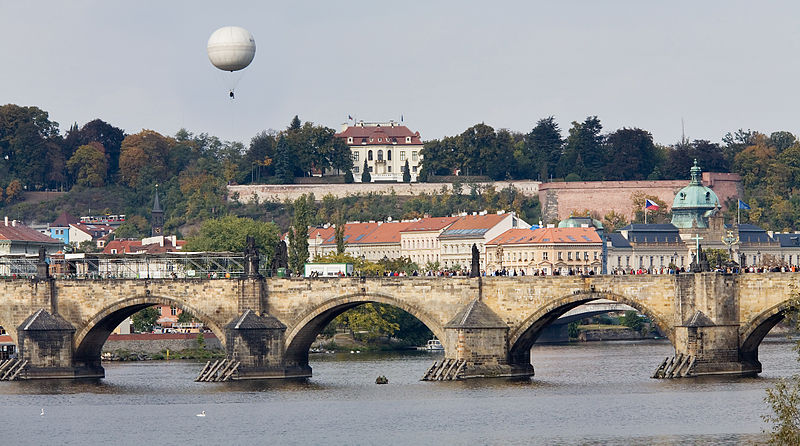
St. Charles Bridge in Prague © Jorge Royan / http://www.royan.com.arCC-BY-SA-3.0 under   Creative Commons Attribution-Share Alike 3.0 Unported

22 January 2013

La cuisine fusion

Having been away from the U.S. for a year and a half, there are definitely foods and flavors we are missing.  Initially, we really missed Mexican food, improvising with chile peppers for jalapeños, and white or kidney beans for pinto beans.  We've gratefully accepted and frozen 100% corn tortillas from the U.S., yet we do appreciate the excellent avocados, coriandre (cilantro or fresh coriander) and seasonal tomatoes here.  More recently, it's the flavors of Asian food that we are craving.  There are several ethnic food stores in Aix, specializing in halal (food prepared according to Muslim dietary rules), orientale (Asian), and exotique (some of the above).  The one closest to us stocks the Asian foods we are most familiar with given our Seattle ties, and lately, I have been there more frequently than usual, adding tamarind paste, miso paste, and lemongrass to my regular purchases of fresh bok choy, soy sauce, noodles, and rice.  This is in part thanks to our purchase of a cookbook from the British-based restaurant chain Wagamama, which we visited twice while in London.  Certainly, Aix restaurants offer la cuisine orientale (Asian food), especially Chinese, Japanese and Vietnamese, but what's missing are the Asian fusion foods that are so typical in the bigger U.S. cities, and that we so happily discovered in London.  We miss that amalgam of flavors and menus and ethnic specialties, where lemongrass mixes with soy sauce mixes with ketchup, and Korean noodles find themselves in Japanese miso broths alongside Chinese cabbage.  Some call this 'fake' Asian food, but what is authentic food anyway?

Here in France, one might say we are eating somewhat more authentic national cuisine, as it seems that everyone living here is intimately familiar with this cuisine, with its ingredients, how it's prepared, and how one eats it.  Traditional French foods we've eaten in the past weeks have included les entrées (appetizers) of escargot, or snails, main dishes of daube (meats cooked in wine sauces) or confit de canard (duck legs in their own fat), and plenty of cheeses and desserts.  Our kids' school meals are especially traditionally French, in the number of courses and what they contain.  In the U.S. on the other hand, we have grown up eating from a much broader plate, where meals, even single dishes, are comprised of a variety of ethnic flavors and foods.  When you think about it, all of American cuisine is fusion-based, since most 'American' foods have come to the U.S. via the movement of people across borders, from all directions.  (Much of it comes from immigration processes, but we also must account for the forced migrations and uprootings of peoples too, all of whom have and had their own food traditions.)  In the process, whatever traditional, 'authentic' recipes were brought by immigrants, or slaves, or indentured servants, have been fused to what is locally available (remember the stories of how the natives taught new arrivals how to plant corn?).  Later, the flavors of the meals become more complex with increased interactions with other new arrivals of different backgrounds.  In some respects many so-called traditional foods are not even so similar or authentic anymore to what is made back in the country-of-origin, such as the 'Chinese food' or 'Tex-Mex food' in the United States.  In my own ethnic traditions, even the processes have changed, in the opposite direction; what I learned to prepare from my immigrant mother were the Finnish holiday sweets, made 'authentically' from scratch, where butter pastries were laboriously mixed and folded over and over before being rolled out, and fillings were cooked from scratch, whereas my friends and cousins in Finland just go to the grocery store and buy the cookie doughs and fillings ready made.  The theme, of fusion, is something one recognizes with other social forces too, and not just in relation to food preparation and the meals themselves.  For example, this quarter in my sociology of religion course, we explore how the effects of immigration and the interactions and experiences with new people in a new place often result in new forms of immigrant religious practice.  Surely, these feel authentic to those following them.

As for France, its sources of immigration are much tighter geographically (coming mostly from the south and east), and thus, the external influences on its foods (and other practices) feel narrower or smaller.  There are certainly regional variations in the French cuisine that are influenced in part by the movement of people across borders, from the heavier German-style cuisine in the northeast Alsace region to the Mediterranean flavors here in the south.   Yet, it still seems to me that there is a tighter definition of what French food is and how it is prepared and experienced, and this is shared across the entire country.  Maybe it's because of the French school system's lunch offerings or standardized French geography lessons where children learn about the culinary and viticultural specialties of each region.  Maybe it's the relatively narrower range of foods available in regular grocery stores.  Or perhaps immigrants here face greater pressures to assimilate to French ways; people here are either French or they are foreigners, and fused, hyphenated, French-something or other identities are not as commonly expressed or recognized as they are in the U.S.  Whatever it is, as foreigners here, I feel grateful to be able to experience French cuisine, however authentic it is or isn't, in the place where it originated, while also satisfying my family's hankerings for foods from 'home'.

So, you can just call me a wagamama,* as I cook my way through my new cookbook, creating new fusions of la cuisine fusion, where tonight's Asian-influenced mackerel with soy and ginger was in fact pêche en Méditerranée (fished from the Med's waters) and the spicy vegetable stir-fry consisted of bok choy grown in the French town of Orange, west of here, and the peppers came from Vietnam.

*Or am I?  Apparently, a wagamama is not a mama at all, but a willful person, or even a naughty child, perhaps meant to signify the restaurant chain's philosophy of not following any one food tradition too religiously.  (http://www.wagamama.com/about-us)

18 December 2012

Vrai ou faux?


As any English-speaking foreigner here knows, some of the most embarrassing language issues center on faux amis (false friends), those expressions in one language that seem like similar ones in another, but in fact, mean something entirely different.  They are like tricks, familiar enough to trip up the reader, and the more I try to learn French, the more it seems I stumble upon them.  For example, one of my friends (a real and true human one) was telling me a few weeks ago that she was going to Marseille to buying some baskets for her daughter for Christmas because she couldn't find the right ones in the right size in Aix.  I wondered just what kind of sweet little baskets she was looking for.  Well, it wasn't the wicker kind at all, but the kind pictured here, because baskets are not baskets in French, but high top sneakers.  (A basket is a panier or corbeille in French.)  Similarly, when we first arrived in Aix, I was asked by someone if my twins were vrai ou faux (true or false).  I managed to keep my indignation to myself when I realized that in fact, those two boys whom I carried for nearly 9 months and birthed as twins are not vrai jumeaux (true, or identical twins) in French, but faux (fraternal, or false) ones, however false it feels to call them that.  Much of French usage is context-based, and there are many of these faux 'faux amis' where a single word can actually mean two different things, depending on the context.  It's like this flocked-to-the-extreme red Christmas tree which I discovered this week on the street in Aix; it looks faux, but in fact is real!


Other language deceptions exist in the realm of pronunciation where there are an awful lot of superfluous letters in French which are not supposed to be pronounced, sometimes.  Those are false friends too in my view.  Young French kids learn French pronunciations and silent letters through memorization, aided by schoolbooks that cross out the silent letters.  I think that would be very helpful for adult learners.  For example, faux amis (silent 's', but do pronounce the 'x' as it carries over to the vowel in the next word: foe za mee) but vrai ou faux  (don't pronounce the x here, vray oo foe), and in those doubly fake friends, faux faux amis (the first x is silent, the second one is not, foe foe za mee).  See what I mean?

In fact, every language plays games with new language learners.  My first language, Finnish, offers nice pronunciation rules, in that every letter in a word is pronounced, so that sounding out words is relatively easy.  But learning what those words mean, and how to use them becomes very difficult when one realizes that long compound words are very common, and that there are over a dozen cases that must be learned; a word like vesi (water) becomes a very different word depending on whether you want to drink it, go in to it, moisten something with it, or are admiring it.  Dangerous deceptions lurk here too; years ago, when I was learning basic Estonian which is closely related to Finnish, I discovered plenty of faux amis, where a word in Finnish like halpa (inexpensive), used perhaps by Finnish tourists when marveling over cheap prices in Estonia, sounds very bad to Estonians because to them halb means bad, or poor quality.  Of course, English is difficult too, with the many homonyms (their, there, they're) and silent letters and difficult sounds: ch, sh, th.

The only consolation is that eventually after enough encounters with different kinds of faux amis, one learns from one's mistakes.  It's rare to meet a faux ami a second time.  Instead, over time, one is able to turn these false friendships into true ones where the once-tricky words or pronunciations actually become useful communication tools, for exchanging niceties, or asking questions, or even sharing confidences, say with neighbors, teachers, or friends.  At those times, the language used may still not come out correctly (it rarely does for me!), but at least there is enough there to create a true and real social connection.