Showing posts with label Durkheim. Show all posts

05 February 2014

A moment of loudness

In a twist, today at 12:12 pm, the state of Washington will have observed a moment of loudness, in celebration of the Seattle Seahawks professional football team's recent Superbowl victory.  That shared moment will no doubt have been most deeply felt and expressed by the thousands of victory parade attendees in downtown Seattle, while other fans are decked out in fan gear as they go into school and work today.  (The superintendent of the Seattle public schools apparently misjudged the fervor of the fans in the city and had to back down from his initially firm statement that school absences to attend the parade would not be considered 'excused' by the school district. Local King5 news has reported on tv that over 500 of the 3000 district school teachers are absent today, and 13,000 students out of 50,000 are out.)  Markers of fandom are still visible in the aftermath of last Sunday's game, with ornaments and flags on homes, yards and cars all over Washington state (and apparently elsewhere, among non-Washingtonian fan club members, see "Vancouver Seahawks fans are Superbowl Ready," Jan. 31, 2014, CBC news).  The flags and jerseys depicting the #12 are especially popular (see flag in photo below).  It's not an idea original to Seattle apparently (see Ballard, Chris. "Into the belly of beast mode in Seattle's 12th man," Nov. 6, 2013, Sports Illustrated), but it has cleverly linked more fans to the team and created new merchandising opportunities.  As a single entity, the fans are depicted as the imaginary but instrumental 12th man on the 11-man team roster.  Those fans, the ones with tickets to home games anyway, have been credited with creating so much noise inside the stadium that they have helped derail opposing teams' efforts.  Presumably, other Seahawks fans wearing #12 jerseys while watching at home on tv contribute in spirit.

Such fandom represents the quest for social solidarity in modern society. It is similar to the religious fervor that ties people together and that fosters essential social cohesion of which sociologist Emile Durkheim spoke over a century ago. Social connectedness is what gives meaning to people in their lives as members of communities on multiple levels. Without it, societies would cease to exist. In the past, shared religious beliefs were the source of such ties in much of the West (and continues in some parts of the world), while nationalism, or national pride is a more modern source. In the current era, love of country is often supplanted by enthusiastic fandom focused on loyalty to sports teams and their wins and losses. Wars between countries fought on fields and trenches become socially constructed as war-like athletic skirmishes on artificial grass fields created by a "civilian leisure class", as Steve Almond notes in his riff about football and its real physical risks for players (
"Is it immoral to watch the superbowl?" Jan. 24, 2014, The New York Times Magazine).  Some sporting events bring together national pride and sports fandom such as the Olympic games beginning today in Sochi, Russia. 

source: http://blog.thenewstribune.com/seahawks/files/2012/05/MemorialDay.jpeg
The connections between war and sport, and religion and sport are nothing new.  Neither are the intense feelings and the potential fanaticism that these all may bring about, and that spell potential danger. (Fan is short for fanatic.)  When groups of fans recognize and bond tightly over shared identities or feelings and expressions, the implication that often follows is that if we are this, then THEY, those people and groups who are not us, are something else, not as good, not as smart, not as human perhaps. This us vs. them mentality is inescapable even when the distinctions are really quite weak.  Obviously there is nothing that inherently different from a Seahawks fan or a Denver Broncos fan, or a Olympique Marseille fan and a Paris Saint-Germain fan if we want to talk football as the rest of the world knows it. Yet, in my family's short experience as denizens of the south of France, we quickly learned that it was interdit (forbidden) to root for the Paris team, even when this team was playing a foreign team such as Barcelona's team!  (Read my take on French football rivalries here: Allez les gars! Nov 26, 2012)  In this case, team loyalties seemed to go much farther than nationalistic ties, and sometimes these have led to fights and vandalism between warring fans.  When local or national or religious or sports pride supersedes good judgment and mutual respect for fellow humans, that is when we get into trouble and undermine our humanity.  It is our shared and more fundamental identities as human beings and citizens of planet Earth that would seem to be more significant (at least until we discover other analogous life forms elsewhere).  Go world!


11 April 2012

Département 13

As with foreigners everywhere, we are often asked where we are from.  We say we are Américains or in my case, Finlandaise-Américaine, and we usually add the detail that nous venons de Washington (we come from Washington).  People here often think we mean Washington D.C., and we swiftly correct them, clarifying more specifically that we are from the WEST coast, from SEATTLE, yes, from Microsoft country (in my childhood, I remember the business reference was Boeing).  For us, it has been important that we establish our national and regional identity correctly.  In one way, this shows that we feel connected to certain places and the people within them, and we want to affirm, if just to ourselves, that this connection still exists even if we have left.  People who have not left their homes also often invoke their social connectedness to particular regions and places, to perhaps reinforce or reassert their ties, out of pride or when challenged.  French sociologist Emile Durkheim considered such social ties vitally important.  He suggested, over a century ago, that social solidarity, or that 'we-feeling' among people in a particular area, sustained communities and gave their members shared purposes and meanings.  Social solidarity is not a natural, intrinsic quality but one that is socially created, in part by the human desire to belong and to survive.  It is also something that starts at the local level, in one's village or town, where we establish connections to those with whom we interact personally and regularly, and it is only through great social, economic and political changes that we have come to a point where social connections can occur on the national level.

Revolution and the eventual creation of la République française contribute in part to the importance of national identity in France today.  We have found that many French are keen to know our nationalities (even if they are less interested in the distinctions between the two Washingtons).  To our faces, most are kind and nod knowingly when we explain where we are from.  (We've heard our share of derisive comments about being American, mostly from French middle school kids and we ignore these as much as we can).  The French also seem to assert their nationality proudly, and many want to know how we, as Americans, like France.  We are asked this almost weekly.  Many seem satisfied when we tell about our appreciations for French food and the French lifestyle.  Others agree with our frustrations with French bureaucracy.  Still others want to know more; last fall I had a conversation with a doctor who spoke in generalizations with me about what "the French" think about politics and feminism, and she wanted me to comment on what "the Americans" think.  It was very difficult for me to speak for Americans on any of the issues we discussed without carefully qualifying my remarks.  I thought it was interesting that she did not qualify whom she was speaking for, when we do know that being French does not have the same meaning for all who live here nor does it seem to include everyone, especially those who don't necessarily look or act the part.
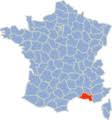
As for regional ties among the French,  I'd known, from the little reading I'd done, that for a long time, the French citizenry was seen as consisting of those from Paris and those from the rest of France.  (The desire to begin understanding the rest of the French is what spurred me to read Graham Robb's prize-winning people's history last fall, The Discovery of France, 2007).  The rest of the French are actually a complex lot, just like the wines they produce!  The French state recognized this when it began to create the administrative geographical divisions that still persist today.  In fact, it seems like regional French identities have in part been forged or socially constructed by the state.  Today there are 27 régions and within them are a total of 101 départements.  We live in the région Provence-Alpes-Côte d'Azur, and within our région, there are 6 départements.  We are #13, also known as Bouches-du-Rhône, which is highlighted in red on the map above.  #13 identifies our postal code, the number appears on our license plates, and the number has popped in school and other affairs.  This past weekend we were skiing, in #73.  It was a saleswoman who explained the numbering on my spouse's souvenir shirt and the red shields with the white crosses that were displayed everywhere in the villages we visited.  These are both emblems of the alpine département Savoie, also known as #73, which lies within the region Rhône-Alpes.  It is probably true that the départements in France have some social salience to the people who live in them, especially if the numerical identifications appear over and over on the things that make up everyday life.

I suggested in my initial paragraph though that most people feel their strongest, most meaningful social connections with others in their immediate locality.  Unfortunately, I haven't been in France long enough or spoken to enough people to be able to offer insights yet on local connections.  My strongest indication that local ties matter is the response we've gotten from other French when we tell them we live in Aix-en-Provence.  More than a few times, we've been told that while Aix is a fine town, it's a little 'bourgeois'.  I've been really curious to know what the speakers mean by this, and I'm guessing I may get a better idea very soon.  As the French go the polls in the next three weeks, to elect that person who will be their President and represent them all, as French, as denizens of this région or that département, and as town dwellers and villagers, I am hoping the voting returns will show more clearly some of the other ways that the people here relate to each other and to their communities.  Perhaps I'll also learn what makes some of them think that our little town is so bourgeois.


Image of U.S.: http://upload.wikimedia.org/wikipedia/commons/thumb/3/30/Washington_in_United_States.svg/270px-Washington_in_United_States.svg.png

Image of France: https://encrypted-tbn0.google.com/images?q=tbn:ANd9GcRjZ6Kt7_6rCwbYsL1-Wrf2M_gtNWzu7wkZzVL-zGWqc7WIFwIh

Image of Aix-en-Provence: http://en.aixenprovencetourism.com/photos_provence/355-plan-centre-a-imprimer.jpg

08 March 2012

La journée de la femme

There I am, in Lyon, under the sign marking Auguste Comte street in Lyon.  Comte is often described as one of the fathers of sociology because his philosophy of positivism informed the developing field of sociology, by suggesting that social reality could and should be explained based on systematic analyses of empirical data, rather than by traditional beliefs and personal experiences.  Perhaps you notice in the photo also the red light and do-not-enter sign behind me.  I usually think of Comte as a green light kind of guy, you know, because he was a positivist, but the red light near his name can serve as a reminder to proceed with caution when we make generalizations about social life, to make sure that these are indeed grounded in empirical findings.  The red light and the do-not-enter sign could also be emblematic of something else, because when sociology was evolving as a scientific discipline, it was largely closed to women.  We have several 'fathers' in the field (Emile Durkheim is often named as the other one), but it is many decades before we can recognize any prominent women in the field.

Today, the light is no longer red, but it seems to be stuck on yellow, as women's positions still lag behind men's, on all kinds of markers.  We have empirical evidence that affirms this for us.  Just last week, my SOC 101 students looked at the gender gap in pay for U.S. adults as reflected in the New York Times, and many of them, men and women alike, were dismayed by the gender gaps in virtually all fields, up to 40% in some.  (See http://www.nytimes.com/interactive/2009/03/01/business/20090301_WageGap.html) The story is very similar here in France.  Today is la journée de la femme, (international woman's day), a day that has official status in France in fact.  I saw signs on the street in Lyon encouraging the cultivation of gender equality and women's rights, (as shown on the pink poster), and the Olympique Lyonnais soccer club shop offered women a discount today on women's fan wear (alas, I don't wear much soccer fanware so the discount was not useful to me).  And the papers also noted the day.  Le Figaro, one of the national papers, offered two articles, one asking various people if such a day is still necessary and if it really advances the cause of women's equality (non seems to have been the general response).  Another article on the same page presents the latest findings on gender equality in France, and the title says it all, Les lents progrès de la parité (by Agnes Leclair, 8 March 2012, The slow progress towards equality).  The article presents a study from Insee, the institute for national statistics, that shows that French women earn 25% less than French men.  The income gap is similar to that in the U.S. if we refer to the data in the May 2010 New York Times interactive data noted above.  Family work comparisons on the other hand, show some interesting differences between the French and Americans, while also affirming some critical similarities.

For example, it seems that the French do more family work on a daily basis.  We can't compare different studies definitively as the measurements and the categories will vary between them, but the French study suggests that French women do close to 4 hours a day of family work, while U.S. women did about 17 hours a week in 2005, which would translate to about 2.5 hours a day.  That seems a little low for the U.S. while the French estimate is perhaps a little high (for U.S. data, see http://www.nsf.gov/discoveries/disc_images.jsp?cntn_id=111458&org=nsf ), but it does seem that French women do more family work than U.S. women do.  Another big national difference is that French men seem to not have progressed as quickly as American men have, in terms of their family work participation.  Since 1986, according to the L'Insee study, French men have added all of  6 minutes to the amount of family work they do, the daily rate today being about 2 hours 13 minutes.  U.S. studies suggest that U.S. men seem to have moved much more quickly, doubling their weekly hours of family work from 6 to 12.5 between 1976 and 2005.

Despite the national differences, French and U.S. women are very similar.  We see that French women and U.S. women do more than their national male counterparts, and we see that the most significant changes over time have been in terms of women's participation in family work, not in men's.  That is, the notable change is that French and U.S. women are simply doing less family work (and not that men are doing more).  Instead, women have given themselves a green light, to pursue other activities and other means for satisfying family responsibilities.  French and U.S. families today outsource more and more of the work, women are hiring childcare help (French women can use state-provided childcare services of course), gardeners, housecleaners, and they are shopping for prepared foods and other products designed to be simplify household work (robot vacuum cleaners, perhaps?).  Or, they are readjusting their standards, in childcare and in household cleanliness and in the quality of the food they prepare.  This is likely the direction we will continue in, in both France and the U.S.: women will do less, outsiders will do more, and men will slowly do a little more over time.  In that fashion, we may eventually reach gender parity, in family work contributions, and hopefully also in terms of pay.